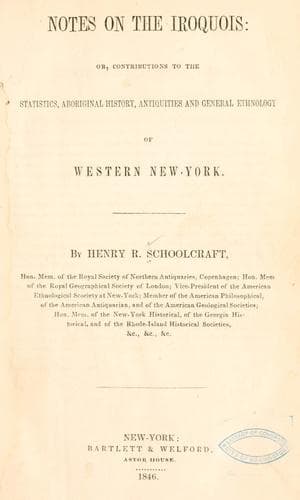
Notes on the Iroquois: or, Contributions to the Statistics, Aboriginal History, Antiquities and General Ethnology of Western New-YorkSchoolcraft, Henry Rowe
History
Notes on the Iroquois: or, Contributions to the Statistics, Aboriginal History, Antiquities and General Ethnology of Western New-York
Schoolcraft, Henry Rowe
Indians of North America -- New York (State); Iroquois Indians
But if such were the influence of pendants, shells, beads and other
amulets or ornaments, inspired by children who saw and heard, what
their parents prized, this influence took a deeper hold of their minds
at and after the period the virile fast, when the power of dreams and
visions was added to the sum of their experimental knowledge of divine
things, so to call them. To fix it still stronger, the Indian system
of medicine, which admits the power of necromancy, lent its aid. And
thus, long before the period which the civilized code has fixed on, to
determine man’s legal acts, the aboriginal man was fixed, grounded and
educated in the doctrine of charms, talismans, and amulets.
To supply the native fabric in this particular branch, was more
difficult. Christianity, in a large part of Europe, certainly all
protestant Europe had, in 1600, religiously discarded all such, and
kindred reliances on amulets, from its ritual and popular observances,
where they had taken deep root during the dark ages; and hence the
first English and Dutch voyagers and settlers who landed north of
the capes of Florida, regarded the use of them as one of the strong
evidences of the heathenishness of the tribes, and made light of their
love of “beads and trinkets.” It was necessary, however, to the success
of their traffic and commerce—the great object of early voyages,
that this class of articles should be noticed; and they brought from
the potteries and glass-houses of Europe various substitutes, in the
shape of white, opaque, transparent, blue, black, and other variously
colored beads, and of as many diverse forms as the genius of geometry
could well devise. We see, what it is somewhat difficult as an inquiry
of art otherwise to reach, that they also brought over a species of
paste-mosaic, or curious oval and elongated beads of a kind of enamel
or paste, skilfully arranged in layers of various colors, which, viewed
at their poles, represented stars, radii, or other figures. These were
highly prized by the natives, (ignorant as they were of the manner of
making them,) and were worn instead of the native amulets. In place
of their carved pipes of steatite, or clay pipes ornamented with the
heads of birds, men, or animals, they supplied them with a somewhat
corresponding heavy, plain, or fluted pipe-bowl, which was designed,
like the native article, to receive a large wooden stem, such as we
see among the remote interior tribes, at the present day. The jingling
ornaments of native copper or deer hoofs, were replaced from European
work-shops, by the article of brass, called “hawks-bells,” an article
which, like that of wampum, still retains its place in the invoices of
the Indian trade.
Public-domain text, read in full here on John Shaqi.
Reviews
Reviews
No reviews yet
Be the first to share your thoughts on this work.
Elsewhere in the archive
Join the Discussion
Join the discussion
Sign in to leave a comment or review.
Sign InorCreate an account