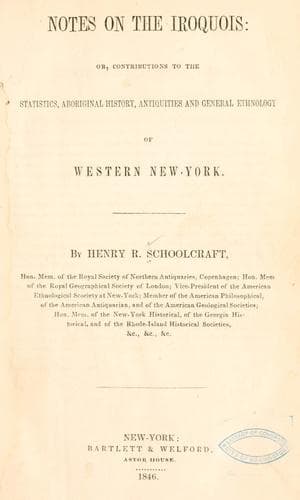
Notes on the Iroquois: or, Contributions to the Statistics, Aboriginal History, Antiquities and General Ethnology of Western New-YorkSchoolcraft, Henry Rowe
History
Notes on the Iroquois: or, Contributions to the Statistics, Aboriginal History, Antiquities and General Ethnology of Western New-York
Schoolcraft, Henry Rowe
Indians of North America -- New York (State); Iroquois Indians
He also dreamt that there was a great giant under the cornfield, who
ate up the corn.
When he revealed these dreams to the chiefs, they determined to abandon
the town, and immediately removed to Buffalo creek. The serpent soon
followed them, and entered the mouth of the creek; but the Great
Spirit, whose especial favorites they ever were, sent lightning to
destroy it. The monster, however, proceeded up the stream, until the
arrows from above fell so thick, that he was obliged to turn. His great
size made him press against the shores, and break off the ground, and
this is the cause of the expanse of the river three miles above its
mouth. Before he reached the mouth of the stream, however, the arrows
had cut him apart and thus they escaped this scourge.
When they went back to visit their old town on the Chippewa river, they
found the giant who had eaten up the corn, hanging by one leg from the
crotch of a high lodge pole, with his body on the ground. He was very
meagre, and had very long and thin legs, with scarcely any flesh on
them. [_W. I. C. Hosmer._]
[If the above is to be regarded, as it clearly must, as an allegory of
sickness and famine, it would have put Greek fancy to the task, to have
concentrated the matter in a smaller compass, or to have exhibited it
in a more striking light.]
[_f._] Allusion to the siege of Fort-Stanwix and the Battle of Oriskany.
Seneca tradition is rife on this subject. Tetayoah says that they lost
thirty-three chiefs in the battle of Oriskany.
Jacob Blacksnake adds, that he has seen a book in which it was stated
that the Senecas had burned eight officers taken at this battle, in
revenge for their losses. This he contradicts, on the authority of his
father, Governor Blacksnake, who was there. The officers had been asked
for after the battle, by the British; but they were refused, on account
of their great losses. They were not, however, burned at the stake. It
was decided that they should run the gauntlet, and they were killed by
clubs, &c. in this ordeal.
[_g._] Defeat of the Kah-Kwahs on Buffalo creek.
Some of the Senecas affirm, that it is ninety years since the battle
with the Kah-Kwahs, on the site of the grave yard, on the Buffalo creek
reservation, was fought. This would place the event in 1755, a date
so modern, and so well known, in our colonial history, as to prove
what a poor figure they make in attempts to adjust chronology. If 190
years [and, perhaps, such should be the tradition,] be taken, the event
(allowing two years for their defence) would assume the precise time
[1655] indicated for it, by one of Le Moyne’s missionary letters, in
which he says, that the war with the Eries had broken out afresh in
1653.
[_h._] Era of the Confederation.
Public-domain text, read in full here on John Shaqi.
Reviews
Reviews
No reviews yet
Be the first to share your thoughts on this work.
Elsewhere in the archive
Join the Discussion
Join the discussion
Sign in to leave a comment or review.
Sign InorCreate an account