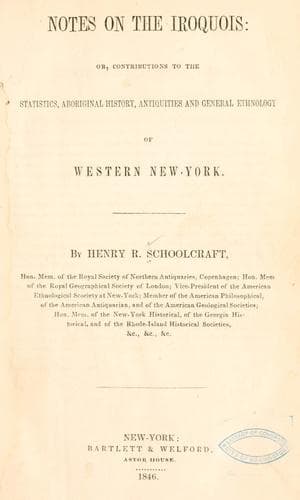
Notes on the Iroquois: or, Contributions to the Statistics, Aboriginal History, Antiquities and General Ethnology of Western New-YorkSchoolcraft, Henry Rowe
History
Notes on the Iroquois: or, Contributions to the Statistics, Aboriginal History, Antiquities and General Ethnology of Western New-York
Schoolcraft, Henry Rowe
Indians of North America -- New York (State); Iroquois Indians
The following communication on this subject, addressed to the Secretary
of the Maryland Historical Society, is added in this connection.
Although written to vindicate a question of antiquarian research, in a
sister society, and partaking perhaps a little of a polemic cast, the
facts are of permanent interest, and are thrown together in a brief and
concentrated form.
_New-York, May 28th, 1845._
GENTLEMEN:[91]
[91] Addressed to the Editors of the New-York Evening Post and
National Intelligencer.
My attention has been called by a literary friend, to your
notice of Mr. Brantz Mayer’s report on the subject of a
national name, or distinctive synonyme for our country. Mr.
Mayer having chosen to reflect upon the antiquarian value of
the historical research involved in the inquiry, I feel called
upon, as a member of the committee of the New-York Historical
Society, before whom this question was discussed, to say a few
words in reply.
“The following quotation from my ‘Glossary of Anglo-Indian
Words,' will best set forth my personal connection with the
subject as a member of the society, and a humble laborer
in the field of aboriginal antiquities, who is ready at all
suitable times, to give authority for the use of whatever
Indian terms he may employ.
”_Alleghan_, an obsolete aboriginal noun proper, applied
adjectively both in French and English, to an ancient and long
extinct people in North America, and likewise to the most
prominent chain of mountains within the regions over which they
are supposed to have borne sway.”
Our authorities respecting the ancient Alleghans, are not confined
to the very late period, _i. e._ 1819,[92] which is alone quoted,
and exclusively relied on by the learned secretary of the Maryland
Historical Society. Nor do they leave us in doubt, that this ancient
people, who occupy the foreground of our remote aboriginal history,
were a valiant, noble and populous race, who were advanced in arts
and the policy of government, and raised fortifications for their
defence. (N. Y. Hist. Col. vol. 2, p. 89, 91.) While they held a
high reputation as hunters, they cultivated maize extensively, which
enabled them to live in large towns; (Davies’ Hist. Car. Isds.) and
erected those antique fortifications which are extended over the entire
Mississippi valley, as high as latitude 43°, and the lake country,
reaching from Lake St. Clair (Am. Phil. Trans.) to the south side of
the Niagara ridge (the old shore of Lake Ontario) and the country of
the Onondagas and Oneidas (Clinton’s Dis. N. Y. Hist. Soc. vol. 2.)
Towards the south, they extended as far as the borders of the Cherokees
and Muscogees.[93] From the traditions of Father Raymond, they were
worshippers of the sun, had an order of priesthood, and exercised a
sovereignty over a very wide area of country. (His. Carib. Isds. Paris,
1658. London ed. of 1666, p. 204, et seq.)
Public-domain text, read in full here on John Shaqi.
Reviews
Reviews
No reviews yet
Be the first to share your thoughts on this work.
Elsewhere in the archive
Join the Discussion
Join the discussion
Sign in to leave a comment or review.
Sign InorCreate an account