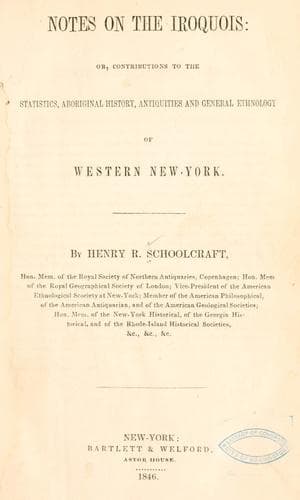
Notes on the Iroquois: or, Contributions to the Statistics, Aboriginal History, Antiquities and General Ethnology of Western New-YorkSchoolcraft, Henry Rowe
History
Notes on the Iroquois: or, Contributions to the Statistics, Aboriginal History, Antiquities and General Ethnology of Western New-York
Schoolcraft, Henry Rowe
Indians of North America -- New York (State); Iroquois Indians
[92] Trans. Hist. and Lit. Com. Am. Phil. Soc. Vol. 1, Philadelphia,
1819.
[93] Seneca tradition, N. Y. Hist. Col. vol. 2.
At what era the Alleghan confederacy, thus shadowed forth, existed
and fell in North America, we do not know. Our Indian nations have
no certain chronology, and we must establish data by contemporaneous
tradition of the Mexican nations, or by internal antiquarian evidence.
The “Old Fort” discovered by Dr. Locke in Highland Co. Ohio in 1838,
denoted a period of 600 years from its abandonment,[94] that is, 284
years before Christopher Columbus first sailed boldly into the Western
ocean. The trees on Grave Creek mound denote the abandonment of the
trenches and stone look-outs in that vicinity to have been in 1338.
(Trans. Am. Ethnological Society, vol. 1, N. Y. 1845.) The ramparts
at Marietta had a tree decayed in the heart, but the concentric outer
circles, which could be counted, were 463. (Clinton’s Dis.) The live
oaks on the low mounds of Florida, where one of the Algonquin tribes,
namely, the Shawnees, aver that they once lived and had been preceded
by a people more advanced in arts (Vide Arch. Am. vol. 1.) denote their
abandonment about 1145. But even these data do not, probably reach back
sufficiently far, to denote the true period.
[94] Cincinnati Gazette.
If we fix upon the twelfth century as the era of the fall of the
Alleghan race, we shall not probably over estimate the event. They
had probably reached the Mississippi valley, a century or two before,
having felt, in their original position, west and south of that stream,
the great revolutionary movements which preceded the overthrow of the
Toltec and the establishment of the Aztec empire in Mexican America.
There are but two words left in our geography, supposed to be of the
ancient Alleghan language. These are Alleghany, and Yioghiogany, the
latter, being the name of a stream which falls into the Monongahela, on
its right bank, about twenty miles above Pittsburgh.
Public-domain text, read in full here on John Shaqi.
Reviews
Reviews
No reviews yet
Be the first to share your thoughts on this work.
Elsewhere in the archive
Join the Discussion
Join the discussion
Sign in to leave a comment or review.
Sign InorCreate an account