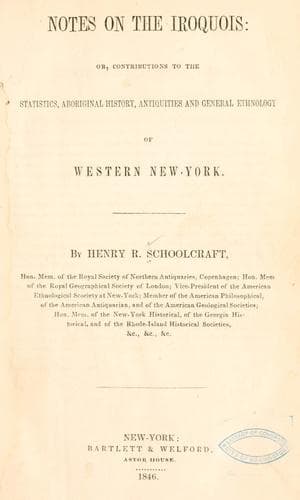
Notes on the Iroquois: or, Contributions to the Statistics, Aboriginal History, Antiquities and General Ethnology of Western New-YorkSchoolcraft, Henry Rowe
History
Notes on the Iroquois: or, Contributions to the Statistics, Aboriginal History, Antiquities and General Ethnology of Western New-York
Schoolcraft, Henry Rowe
Indians of North America -- New York (State); Iroquois Indians
The condition of herdsmen is deemed by theorists and historians to
be the first step in the progress from the hunter state. But we are
in want of all evidence to show that there ever was, in America, a
pastoral state. In the first place, the tribes had tamed no quadruped,
even in the tropics, but the lama. The bison was never under any
subjection, nor a fleece ever gathered, so far as history tells us,
from the Big-horn or Rocky Mountain sheep. The horse, the domestic cow,
the hog and the common sheep, were brought over after the discovery;
and the Iroquois, like most of their western brethren, have been very
slow, all advantages considered, in raising them. They have, in fact,
had no pastoral state, and they have only become herdsmen at the time
that they took hold of the plough. The number of domestic animals now
on their reservations, as shown by the tables, bears a full proportion
to their other industrial field labors. It will be seen, that while
horses, neat cattle and hogs are generally raised, sheep come in, at
more mature periods of advance, and are found only on the largest and
best cultivated farms. Sheep, therefore, like the cereales, become
a test of their advance. With this stage, we generally find, too,
the field esculents, as turnips, peas, &c. and also buckwheat. I
have indicated, as a further proof of their advance as herdsmen and
graziers, the number of acres of meadow cut. The Iroquois cultivate no
flax. They probably raise no rye, from the fact that their lands are
better adapted to wheat and corn.
The potato was certainly indigenous. Sir Walter Raleigh, in his
efforts at colonizations, had it brought from Virginia, under the
original name of _openawg_.[5] But none of the North American tribes
are known to have cultivated it. They dug it up, like other indigenous
edible roots from the forest. But it has long been introduced into
their villages and spread over the northern latitudes, far beyond the
present limit of the zea maize. Its cultivation is so easy and so
similar to that of their favorite corn, and its yield so great, that it
is remarkable it should not have received more general attention from
all the tribes. With the Iroquois, the lists will denote that, in most
cases, it is a mere item of horticulture, most families not planting
over half an acre, often not more than a quarter of an acre, and yet
more frequently, none at all.
[5] By the Algonquins of the present day, this plant is called, in the
plural, _opineeg_. The inflection in _eeg_ denotes the plural.
Public-domain text, read in full here on John Shaqi.
Reviews
Reviews
No reviews yet
Be the first to share your thoughts on this work.
Join the Discussion
Join the discussion
Sign in to leave a comment or review.
Sign InorCreate an account