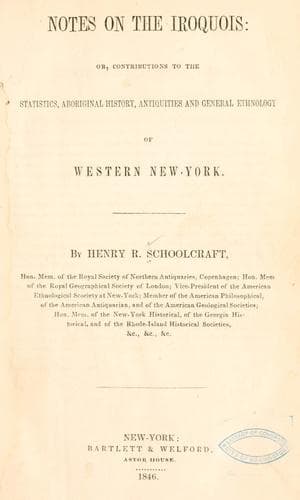
Notes on the Iroquois: or, Contributions to the Statistics, Aboriginal History, Antiquities and General Ethnology of Western New-YorkSchoolcraft, Henry Rowe
History
Notes on the Iroquois: or, Contributions to the Statistics, Aboriginal History, Antiquities and General Ethnology of Western New-York
Schoolcraft, Henry Rowe
Indians of North America -- New York (State); Iroquois Indians
The apple is the Iroquois banana. From the earliest introduction of
this fruit into New-York and New-France, from the genial plains of
Holland and Normandy, these tribes appear to have been captivated
by its taste, and they lost no time in transferring it, by sowing
the seed, to the sites of their ancient castles. No one can read the
accounts of the destruction of the extensive orchards of the apple,
which were cut down, on Gen. Sullivan’s inroad into the Genesee
country in 1779, without regretting that the purposes of war should
have required this barbaric act. The census will show that this taste
remains as strong in 1845, as it was 66 years ago.
Adverse to agricultural labor, and always confounding it with slavery,
or some form of servitude, at least, deeming it derogatory, the first
effort of the Iroquois to advance from their original corn-field and
garden of beans and vines is connected with the letting out of their
spare lands to white men who were cast on the frontiers, to cultivate,
receiving for it some low remuneration in kind or otherwise, by way
of rent. This system, it is true, increased a little their means of
subsistence, but nourished their native pride and indolence. It seems
to have been particularly a practice of the Iroquois, and it has been
continued and incorporated into their present agricultural system. I
have taken pains to indicate, in every family, the amount of land thus
let, and the actual or estimated value received for it. These receipts,
I was informed, low as they are in amount, are generally paid in kind,
or in such manner as often to diminish their value and effect, in
contributing to the proper sustenance of the family.
I have been equally careful to ascertain the number of families who
cultivated no lands, and insert them in the tables. The division of
real property among this people appears to fall under the ordinary
rules of acquisition in other societies. But it is not to be inferred
in all cases, that the individual returned as without land has
absolutely no right to any, or having this right, has either forfeited
or alienated it, although the laws of the tribes respecting property,
permit one Iroquois to convey his property in fee to another. It is
only to be inferred, in every case, that they are non-cultivators. In a
few cases the persons thus marked are mechanics, and rely for support
on their skill. In the valley of the Allegheny, some of them are pilots
in conducting rafts of lumber or arks down that stream. It would have
relieved the industrial means of this band of the Senecas, extended
as they are for forty miles along both banks of this river, could the
amount received for this species of pilotage have been ascertained,
together with the avails derived from several saw-mills owned by them,
and from the lumber trade of that river generally. But these questions
would have remained a blank in other tribes.
Public-domain text, read in full here on John Shaqi.
Reviews
Reviews
No reviews yet
Be the first to share your thoughts on this work.
Join the Discussion
Join the discussion
Sign in to leave a comment or review.
Sign InorCreate an account