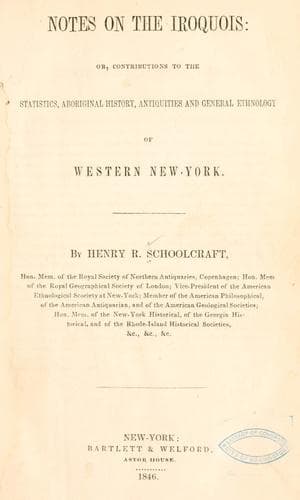
Notes on the Iroquois: or, Contributions to the Statistics, Aboriginal History, Antiquities and General Ethnology of Western New-YorkSchoolcraft, Henry Rowe
History
Notes on the Iroquois: or, Contributions to the Statistics, Aboriginal History, Antiquities and General Ethnology of Western New-York
Schoolcraft, Henry Rowe
Indians of North America -- New York (State); Iroquois Indians
Their plan, after the confederation was to adopt prisoners and
captives, that fragments of tribes who were parted amongst them and
thus lost. They used the term We-hait-wa-tsha, in a figurative sense,
in relation to such tribes. This term means a body cut and quartered
and scattered around. So they aimed to scatter their prisoners among
the other nations. There is still blood of the Cherokees in Onondaga. A
boy of this nation became a chief among the Cherokees.
I called Le Fort’s attention to the residence of the Moravian
missionary, Zœisberger. He said there was no tradition of such
residence—that the oldest men remembered no such mission; that they
were ever strongly opposed to all missionaries after the expulsion of
the Jesuits, and he felt confident no such person, or any person in the
character of a preacher, had lived at Onondaga Castle; that there must
be some mistake in the matter.
ONONDAGA. [Jackson’s.]
Ondiaka told Le Fort that the Onondagas formerly wandered about,
without being long fixed at a place, frequently changing their villages
from slight causes, such as sickness, &c. They were at war with the
other Iroquois bands. They were also at war with other tribes. Hence
forts were necessary, but after they confederated, such defensive
works fell into disuse. They lived in the present areas of De Witt,
Lafayette, Pompey and Manlius, along Butternut creek, &c. Here the
French visited them, and built a fort, after their confederation.
Ephraim Webster stated that the Indians were never as numerous as
appearances led men to think. This appearance of a heavy population
happened from their frequent removals, leaving their old villages,
which soon assumed the appearance of ancient populous settlements.
He told Jas. Gould, that being once on a visit to Canada, he became
acquainted with a very aged Indian, who, one day, beginning to talk of
the Onondaga country, told him that he was born near the old church,
near Jamesville, where there was a very populous village. One evening,
he said, he stepped out of his lodge, and immediately sank in the
earth, and found himself in a large room, surrounded by three hundred
witches and wizzards. Next morning he went to the council, and told the
chiefs of this extraordinary fact. They asked him whether he could not
identify them. He said he could. They then accompanied him on a visit
to all the lodges, when he pointed out this and that one, who were
immediately killed. Before this inquiry ended, and the delusion was
stayed, he says that three hundred persons were killed.
Public-domain text, read in full here on John Shaqi.
Reviews
Reviews
No reviews yet
Be the first to share your thoughts on this work.
Elsewhere in the archive
Join the Discussion
Join the discussion
Sign in to leave a comment or review.
Sign InorCreate an account