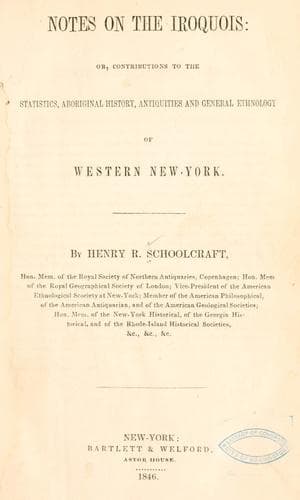
Notes on the Iroquois: or, Contributions to the Statistics, Aboriginal History, Antiquities and General Ethnology of Western New-YorkSchoolcraft, Henry Rowe
History
Notes on the Iroquois: or, Contributions to the Statistics, Aboriginal History, Antiquities and General Ethnology of Western New-York
Schoolcraft, Henry Rowe
Indians of North America -- New York (State); Iroquois Indians
COLE was of the “old school” of his race—a primitive,
unadulterated Indian, equally uncontaminated in mind as in habits,
by intercourse with the whites. Probity and justice were the leading
features of his character; and to direct these he had an intellect
which won for him a high control and extended influence among his tribe.
Some years since COLE was selected by our townsman, young
WILGUS, as the finest specimen he had ever met, of the race
to which he belonged; and he immediately took means to secure him as
a sitter. The result was the half length portrait of the Chief which
WILGUS executed, and which has been so often seen and admired
alike by our citizens and by strangers.
An incident connected with the history of this piece, seems appropriate
here, as illustrative of its excellence. When WILGUS left
for Porto Rico, where he now is, he took the portrait of Cole with
him. It was seen, upon that island, by a gentleman from Amsterdam, who
declared it the first piece he had seen which gave him the slightest
ideas of the peculiar characteristics of the Indian race; and he became
so interested in the picture that he asked and obtained permission to
take it with him, to Europe, for the inspection of his friends. The
piece was, by him, carried to Amsterdam, where the admiration of it
was universal, and where it would have been retained, at almost any
price, had it been for sale. But it was not: the gentleman had promised
to return the painting safe to Buffalo; and he has done so, it having
arrived here this spring; and it now stands, unostentatiously enough,
in the bookstore of the artist’s father, upon Main-street.
BATAVIA.
The Tonewandas at length consent to have their census taken.
AUBURN.
Go with Mr. Goodwin to visit Oswaco lake—Gov. Throop’s place—Old
Dutch Church overlooking the lake, &c.
_Fort-Hill._—Extensive vestiges of an elliptical work—Curious
rectangular fissures of the limestone rock on the Owasco outlet—north
and south.
The Indian name of the place, as told by an Onondaga chief—Osco; first
called Hardenburgh’s Corners, finally named after Goldsmith’s “Deserted
Village”—so that the poet may be said to have had a hand in supplying
names for a land to which he once purposed to migrate.
It would have pleased “poor Goldsmith” could he have known that he was
the parent of the name for so fine a town—a town thriving somewhat on
the principle laid down in the concluding lines of the poem—
“While self-dependent power can time defy,
As rocks resist the billows and the sky.”
SYRACUSE.
Public-domain text, read in full here on John Shaqi.
Reviews
Reviews
No reviews yet
Be the first to share your thoughts on this work.
Elsewhere in the archive
Join the Discussion
Join the discussion
Sign in to leave a comment or review.
Sign InorCreate an account