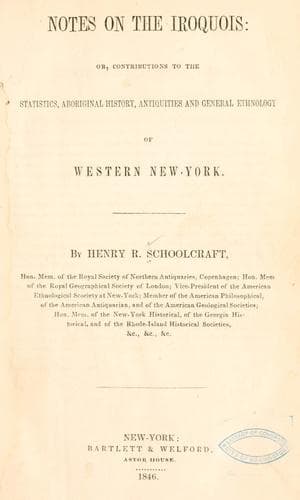
Notes on the Iroquois: or, Contributions to the Statistics, Aboriginal History, Antiquities and General Ethnology of Western New-YorkSchoolcraft, Henry Rowe
History
Notes on the Iroquois: or, Contributions to the Statistics, Aboriginal History, Antiquities and General Ethnology of Western New-York
Schoolcraft, Henry Rowe
Indians of North America -- New York (State); Iroquois Indians
Pity a better name could not have been found for so fine, central,
capital a site. The associations are now all wrong. What had Dionysius
or Archimedes to do here? It was Atotarho Garangula, Dekanifora,
Ontiyaka, and their kindred, who made the place famous. Onondaga
would have been a far better appellation. The Indians called the lake
and its basin of country together Gan-on-do-a. Salt Point, or the
Saline, sounded to me as if, abating syllibants, it might be written
Ka-ji-ka-do.
UTICA.
There was a ford in the Mohawk here. It was the site of Fort
Schuyler—a fort named after Major Schuyler, a man of note and military
prowess in the olden time, long before the days of General Philip
Schuyler. Some philological goose, writing from the Canadas, makes
Utica an Indian name!
MOUTH OF THE NORMAN’S KILL, OR TAWASENTHA, ALBANY.
Mr. Brayton says, that in digging the turnpike road, in ascending
Kiddenhook hill, on the road to Bethlehem, many human bones, supposed
to be Indian, were found. They were so numerous that they were put in a
box and buried. This ancient burial ground, which I visited, was at a
spot where the soil is light and sandy. On the hill, above his house,
is a level field, where arrow-heads have been found in large numbers.
Mr. B., who has lived here sixteen years, does not know that the
isolated high ground, east of the turnpike gate, contains ancient
bones—has not examined it with that view. Says Mr. Russell, in the
neighborhood, has lived there fifty years, and will ask him.
Nothing could be more likely, than that this oasis on the low land
should have served as the cemetery for the Mohawks, who inhabited the
island, where the Dutch first landed and built a fort in 1614.
The occupancy of this island by the Indians could never have been any
thing but a _summer residence_, for it is subject to be inundated every
year by the breaking up of the river. This was probably the cause why
the Dutch almost immediately abandoned it, and went a little higher,
to the main land, where Albany now stands. The city, however, such are
the present signs of its wealth and progress, has extended down quite
half way to the parallel of the original site of “Het Casteel” under
Christians, and should these signs continue, within twenty years South
Pearl-street will present lines of compact dwellings and stores to the
bridge over the Tawasentha, and Kiddenhook be adorned with country
seats.
NEW-YORK.
Whatever else can be done for the red race, it is yet my opinion,
that nothing would be as permanently beneficial, in their exaltation
and preservation, as their admission to the rights and immunities of
citizens.
INDIAN ELECTION.
At a council of the Six Nations of Indians, held upon the Tonawanda
Reservation, on Wednesday, Oct. 1st, there were present the Mohawks,
Onondagas and Senecas, confederate brothers on the one part, and the
Oneidas, Cayugas and Tuscaroras, brothers on the other part.
Public-domain text, read in full here on John Shaqi.
Reviews
Reviews
No reviews yet
Be the first to share your thoughts on this work.
Elsewhere in the archive
Join the Discussion
Join the discussion
Sign in to leave a comment or review.
Sign InorCreate an account