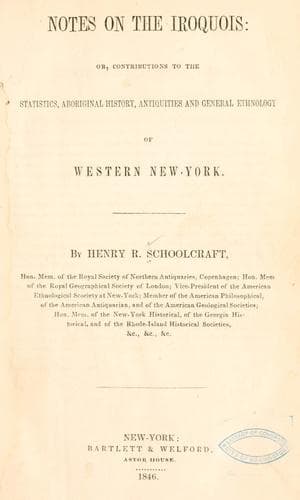
Notes on the Iroquois: or, Contributions to the Statistics, Aboriginal History, Antiquities and General Ethnology of Western New-YorkSchoolcraft, Henry Rowe
History
Notes on the Iroquois: or, Contributions to the Statistics, Aboriginal History, Antiquities and General Ethnology of Western New-York
Schoolcraft, Henry Rowe
Indians of North America -- New York (State); Iroquois Indians
Mr. Jefferson estimates the population of the Powhatanic confederacy or
group of tribes, at one individual to the square mile.[7] Gov. Clinton,
who ably handled the subject in a discourse in 1811, estimates that,
if this rule be applied to the domain of the Iroquois in New-York, an
aggregate of not less than 30,000 would be produced;[8] but he does not
pass his opinion upon an estimate made so completely without reliable
data.
[7] Notes on Virginia.
[8] Coll. N. Y. Hist. Soc. vol. 2.
At a conference with the five cantons at Albany, in 1677, the number
of warriors was carefully made out at 2,150, giving, on the preceding
mode of computation, a population of 10,750, and this was the strength
of the confederacy reported by an agent of the Governor of Virginia,
who had been specially despatched to the conference for the purpose
of obtaining this fact. Either, then, in the subsequent estimates of
1756, ’60, and ’64, the population had been underrated, or there had,
on the assumption of the truth of the above enumeration, which is
moderate, been a decline in the population of 3,000 souls in a period
of eighty-seven years. That there was a constant tendency to decline,
and that the cantons were aware of this, and made efforts to keep it
up, by the policy of their conquests, is apparent, and has before been
indicated.
During the American revolution, which broke out but eleven years after
the expedition and estimate of Bouquet, when he had put the Iroquois
at 1,550 fighting men, it is estimated that the British government had
in their interest and service 1,580 warriors of this confederacy. The
highest number noticed of the friendly Oneidas and a few others, who
sided with us in that contest, is 230 warriors, raising the number
of armed men engaged in the war, to 1,810, and the gross population
in 1776 to 9,050 souls. This estimate, which appears to have been
carefully made, from authentic documents, is the utmost that could
well be claimed. It was made at the era when danger prompted the pen
of either party in the war to exhibit the military strength of this
confederacy, in its utmost power; and we may rest here, as a safe point
of comparison, or, at least, we cannot admit a higher population.
By the census returns herewith submitted, the aggregate population of
the three full, and four fragmentary cantons, namely, the Oneidas and
Cayugas, &c. still residing within the State, are denoted to be as
follows, namely:
Senecas, 2,441
Onondaga, 398
Tuscaroras, 281
Oneidas, 210
Cayugas, 123
Mohawks, 20
St. Regis Canton, 360
Public-domain text, read in full here on John Shaqi.
Reviews
Reviews
No reviews yet
Be the first to share your thoughts on this work.
Join the Discussion
Join the discussion
Sign in to leave a comment or review.
Sign InorCreate an account