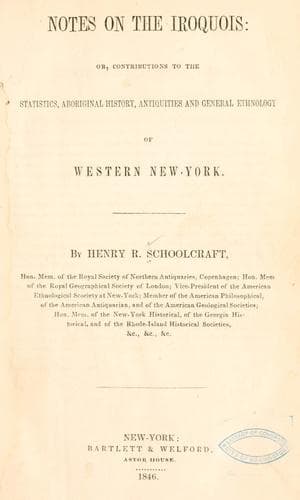
Notes on the Iroquois: or, Contributions to the Statistics, Aboriginal History, Antiquities and General Ethnology of Western New-York — John Shaqi
Notes on the Iroquois: or, Contributions to the Statistics, Aboriginal History, Antiquities and General Ethnology of Western New-YorkSchoolcraft, Henry Rowe
History
Notes on the Iroquois: or, Contributions to the Statistics, Aboriginal History, Antiquities and General Ethnology of Western New-York
Schoolcraft, Henry Rowe
Indians of North America -- New York (State); Iroquois Indians
who, at the last accounts (vide President’s Message to Congress,
1844,) number in the aggregate 336 souls. They are located on the
Neosho river, (a branch of the Arkansas,) west of the western boundary
of the State of Arkansas, where the reports of the government agents
represent them as raising horses, cattle and other stock, and being
producers of grain. In any view, the subject of the several classes
of persons represented in the accompanying tables, as semi-hunters
and non-cultivators, or individuals without lands, is one entitled to
attention. They should not be permitted to live within the boundaries
of the State without lands. The State should cherish all who choose to
remain as vestiges of a once powerful race, to whose wisdom and bravery
we owe the preservation of the domain. It would be unjust to expect the
industrious and forehanded Iroquois to redivide their lands with the
poor, and, to some extent, thriftless numbers of the cantons; while it
may, at the same time be observed, that it would be very difficult,
if not impossible, to provide by legislation, suitable guards against
their deterioration and depopulation in their present locations without
destroying wholly the fabric of their confederation, chieftainships and
laws.
IV. Whether the Iroquois have advanced in population since they
have laid aside the character of warriors and hunters, and adopted
agriculture as their only means of support, we have no accurate data
for determining. That their ancient population was overrated, and _very
much_ overrated, at all periods of our history, there can be little
question. We may dismiss many of these rude conjectures, of the elder
writers, as entitled to little notice, particularly that of La Houton,
who estimates each canton at 14,000 souls. Still, after making every
abatement for this tendency in the earlier authors to exaggerate their
actual numbers, it could have been no small population, which, at
one time, attacked the island of Montreal with twelve hundred armed
warriors, and at another (1683) marched a thousand men against the
Ottagamies.[6]
[6] Colden’s Five Nations.
Smith puts the whole number of fighting men, in 1756, with a moderation
which is remarkable, compared to others who had touched the subject,
at about twelve hundred. Giving to each warrior a home population of
_five_, which is found to hold good, in modern days, in the great
area of the west, we should have an aggregate of 6,000—a result,
which is, probably, too low. Douglass, four years afterwards, gives
us data for raising this estimate to 7,500. Col. Bouquet, still four
years later, raises this latter estimate by 250. It must be evident
that their perpetual wars had a tendency to keep down their numbers,
notwithstanding their policy of aiding their natural increase by the
adoption and incorporation into the cantons, in full independence, of
prisoners and captives.
Public-domain text, read in full here on John Shaqi.
Reviews
Reviews
No reviews yet
Be the first to share your thoughts on this work.
Join the Discussion
Join the discussion
Sign in to leave a comment or review.
Sign InorCreate an account