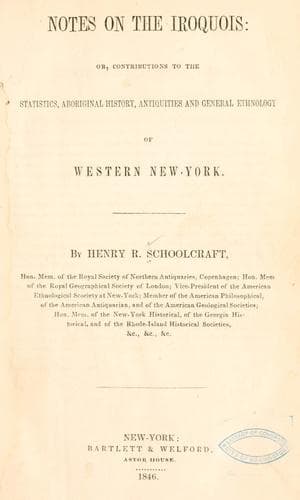
Notes on the Iroquois: or, Contributions to the Statistics, Aboriginal History, Antiquities and General Ethnology of Western New-YorkSchoolcraft, Henry Rowe
History
Notes on the Iroquois: or, Contributions to the Statistics, Aboriginal History, Antiquities and General Ethnology of Western New-York
Schoolcraft, Henry Rowe
Indians of North America -- New York (State); Iroquois Indians
Arrow-heads, made of flint or horn-stone, gouges, pestles, hatchets,
and other weapons formed from stone, have been found about the “Hill”
and throughout this section. Of the rarer articles, are pipes and
beads, a few of the latter of which I have been able to obtain. The
gouges, pestles and hatchets, are, I think, frequently made of compact
limestone, probably what is now known in Mr. Hall’s State report as
the _one foot limestone_ at Le Roy, though many of them seem to be
formed of primitive rock, and very likely were worked out from boulders
scattered about the country.
Skeletons found about “Fort Hill” and its vicinity sustain the
impression that the former occupants of this “military station” were
of a larger and more powerful race of men than ourselves. I learned
that the skeletons generally indicated a stouter and larger frame.
An humerus or shoulder bone of which preserved may safely be said to
be one-third larger or stouter than any now swung by the living. A
resident of Batavia, THOMAS T. EVERETT, M. D., has in his
cabinet a portion of a lower jaw bone full one-third larger than any
possessed by the present race of men, which was found in a hill near
Le Roy, some two years since. From the same hill arrow-heads and other
articles have been removed for many years.
The articles I send you are as follows:—No. 1, an Indian gouge, made
of very hard stone, found at “Fort Hill;” No. 3, arrow-heads, of flint;
No. 4, beads; No. 5, a bead, evidently formed from a tooth, as the
enamel and other distinctive marks indicate; No. 6, a bead, apparently
of bone.
No. 2 is a stone tomahawk, presented to me by JEROME A. CLARK,
Esq., of this village. It was found on his premises half a mile south
of this place. I herewith present it to you.
These articles I have sent to-day by a friend, and you will find
them by calling at Tammany Hall. I have not yet been able to visit
Tonawanda, but am in hopes to do so in a day or two.
Your ob’t serv’t,
FREDERICK FOLLETT.
(G.)
Letter from C. Dewey to Henry R. Schoolcraft.
FORT HILL.
This is celebrated as being the remains of some ancient work, and was
supposed to have been a _fort_. Though the name is pronounced as if
_hill_ was the name of some individual, yet the place is a fort on a
hill, in the loose use of the word. The name designates the place as
_Fort_-hill, to distinguish it from the hills which have no fort on
them. Neither is it _a hill_, except as you rise from the swale on the
north, for it is lower than the land to which it naturally belongs.
As you pass towards Fort-Hill in the road from Le Roy village, which
is about three miles to the south, you descend a little most of the
distance to this place. The road passes a little west of the middle of
the space nearly north and south.
The shape is quadrangular, and is shown in the diagram or ground plot.
Public-domain text, read in full here on John Shaqi.
Reviews
Reviews
No reviews yet
Be the first to share your thoughts on this work.
Elsewhere in the archive
Join the Discussion
Join the discussion
Sign in to leave a comment or review.
Sign InorCreate an account