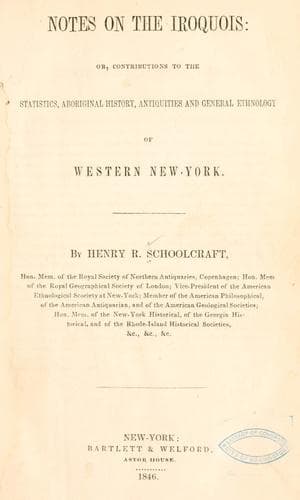
Notes on the Iroquois: or, Contributions to the Statistics, Aboriginal History, Antiquities and General Ethnology of Western New-YorkSchoolcraft, Henry Rowe
History
Notes on the Iroquois: or, Contributions to the Statistics, Aboriginal History, Antiquities and General Ethnology of Western New-York
Schoolcraft, Henry Rowe
Indians of North America -- New York (State); Iroquois Indians
I regret, indeed, that time has not permitted me to enter more fully on
some of the topics introduced, and that of others, I have been obliged
to cut them short or omit them altogether, including the subject of
their languages, geographical terminology, and personal names, the
latter of which is a very curious inquiry of itself. I confess it would
have fallen in with my inclinations, as well as my conceptions of
the true nature and extent of the inquiries confided to me, to have
extended them to other parts of the State, and given a more complete
view of our ethnology, had it been practicable to do so before the
meeting of the Legislature.
I cannot, however, close this note without expressing the hope that the
Legislature will authorize you to take further measures for completing
the work. There are a large number of the class of antique, circular
and elliptical works scattered over the western and southwestern part
of the State, of an age anterior to the discovery, which it would be
important to examine and describe. These chiefly lie west of Cayuga,
and upon the sources of the Susquehanna. Interspersed amid this system
of common ring-forts of the west there are some of a still earlier
period, which exhibit squares and parallelograms, yet without any
defensive work in the nature of bastions.
The area of early French occupancy, or attempt at colonization, within
the State, extends east and west between the waters of the Cayuga and
Oneida lakes, as general boundaries, having the county of Onondaga
as its chief and central point. This area will comprehend the most
striking part of the numerous remains of implements of art, and
other antiquities of European origin, which have heretofore excited
attention. How far these evidences extend north is not known. But
any examination of either the aboriginal or foreign remains would be
incomplete which did not extend also along the line of the St. Lawrence
and the waters of Lake Champlain.
The valley of the Hudson, and the southern part of the State generally,
although it has not been explored with this view, is known to have some
antiquarian features worthy examination. And were there none others
than the artificial shell mounds and beds on the sea coast and the
fossil bones of the valley, so remarkable in themselves, these would
alone be entitled to the highest interest in studying the ancient
history of the races of man in this area.
Geological action subsequent to the period of the habitation of the
globe, has not been examined with this view, but is believed to be
important in denoting eras of former occupancy; it is known that
various parts of the State have yielded, at considerable depths below
the surface, many curious evidences of artificial remains, along with
relics of the animal and vegetable kingdoms.
Public-domain text, read in full here on John Shaqi.
Reviews
Reviews
No reviews yet
Be the first to share your thoughts on this work.
Join the Discussion
Join the discussion
Sign in to leave a comment or review.
Sign InorCreate an account