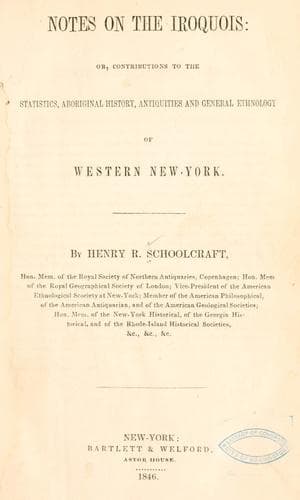
Notes on the Iroquois: or, Contributions to the Statistics, Aboriginal History, Antiquities and General Ethnology of Western New-YorkSchoolcraft, Henry Rowe
History
Notes on the Iroquois: or, Contributions to the Statistics, Aboriginal History, Antiquities and General Ethnology of Western New-York
Schoolcraft, Henry Rowe
Indians of North America -- New York (State); Iroquois Indians
There is an apparent extension of the system of works which
characterize the fort and mound period of the Ohio valley, reaching
from the Alleghany waters in Chautauque and Cattaraugus, along the
southern shore of Lake Erie, indefinitely eastward, which it would be
interesting to trace.
One of the most reliable proofs of eras and races of men is found in
the remains of art.
There are some striking coincidences in this respect between the
antiquities of New-York and the Mississippi valley, which denote
precisely the same state of arts and the same eras of occupancy.
Such are the Minace Alleghanic which occurs alike in the Grave Creek
mound and the simple places of sepulture in Onondaga, the Nabikoaguna
Antique, which has been found at Upper Sandusky and at Onondaga; and
the Medaëka Missouri, from the valley of the Sciota, in Ohio, and the
Kasonda in New-York.
Accurate descriptions of the whole class of our antiquarian remains
could not, if thoroughly executed, but throw much light on, and
introduce precision in, periods of remote history in this State, and
indeed the continent, which are now either involved in obscurity, or
constitute themes of mere conjecture.
I. HISTORICAL AND ETHNOLOGICAL MINUTES.
MADE ON TAKING THE CENSUS OF THE IROQUOIS OF NEW-YORK, IN CONFORMITY
WITH AN ACT OF THE LEGISLATURE, IN 1845.
[_a._] A Sketch of the Iroquois Groupe of Aboriginal Tribes.
On the discovery of North America, the Iroquois tribes, were found
seated chiefly in the wide and fertile territory of western and
northern New-York, reaching west to the sources of the Ohio;[10] north,
to the banks of Lake Champlain and the St. Lawrence; and east, to the
site of Albany. They had as much nationality of character, then, as any
of the populous tribes, who, in the 4th century wandered over central
and western Europe. They were, in a high degree, warlike, handling the
bow and arrow with the skill and dexterity of the ancient Thracians and
Parthians. They were confederated in peace and war, and had begun to
lay the foundations of a power, against which, the surrounding nations,
in the Mississippi valley, and along the St. Lawrence, the Hudson,
and the Delaware, could not stand. The French, when they effectually
entered the St. Lawrence in 1608,[11] courted their alliance on the
north, and the Dutch did the same in 1609, on the Hudson. Virginia had
been apprised of their power, at an early day, and the other English
colonies, as they arrived, were soon made acquainted with the existence
of this native confederacy in the north. By putting fire-arms into
their hands, they doubled the aboriginal power, and became themselves,
for more than a century, dependant on their caprice or friendship.
[10] They always denominated the Alleghany river by the name of Ohio.
This I found to be the term constantly used for that river in 1845.
They give the vowel i, in this word, the sound of i, in machine.
[11] They actually discovered this river, in 1535.
Public-domain text, read in full here on John Shaqi.
Reviews
Reviews
No reviews yet
Be the first to share your thoughts on this work.
Join the Discussion
Join the discussion
Sign in to leave a comment or review.
Sign InorCreate an account