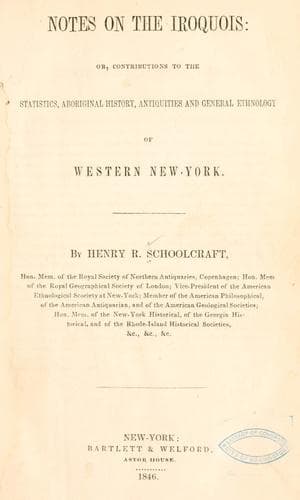
Notes on the Iroquois: or, Contributions to the Statistics, Aboriginal History, Antiquities and General Ethnology of Western New-YorkSchoolcraft, Henry Rowe
History
Notes on the Iroquois: or, Contributions to the Statistics, Aboriginal History, Antiquities and General Ethnology of Western New-York
Schoolcraft, Henry Rowe
Indians of North America -- New York (State); Iroquois Indians
Some twenty or more persons of this tribe are mingled as residents of
the villages of their brethren, the Senecas, Tuscaroras, and Oneidas.
A much greater number exist with intermixture of other kindred tribes,
in the St. Regis canton of St. Lawrence county; but the greater number
of the parent tribe reside on lands appropriated for their use by the
British government, at Brantford, on the Grand river of Canada West. To
this place at the close of the war, they followed their distinguished
leader, Thayendanegea, the Jephtha of his tribe, who, against the
custom of birth and descent, and every other obstacle, after the
failure of the line of wise and brave chiefs to lead them to battle,
was made their Tekarahogea and leader, and displayed a degree of energy
and firmness of purpose, which few of the aboriginal race in America
have ever equalled.
What light the examination of the old places of burial of this tribe in
the valley would throw on their ancient history or arts, by entombed
articles, cannot be told without examinations which have not been
made. Probably the old places of Indian interment about Canajoharie,
Dionderoga, and Schenectady, would reveal something on this head,
conforming at least, in age and style of art, with the stone pipes,
tomahawks and amulets of the Onondaga and Genesee countries. The valley
of the Schoharie and that of the Tawasentha, or Norman’s kill, near
Albany, might also be expected to reward this species of research.
[Vide B.] A human head, rudely carved in stone, apparently aboriginal,
was sent to the New-York Historical Society early in 1845, which was
represented to have been found in excavating a bank at Schenectady. If
this piece of sculpture, which denoted more labor than art, be regarded
as of Mohawk origin, it would evince no higher degree of art, in this
respect, than was evinced by similar outlines cut in the rock, but not
detached, by some of the New-England tribes.[26]
[26] Rude carvings of this kind are represented to exist on the banks
of the Connecticut, at Bellows’ Falls, &c.
[_b._] Origin and History of the Oneidas.
Public-domain text, read in full here on John Shaqi.
Reviews
Reviews
No reviews yet
Be the first to share your thoughts on this work.
Join the Discussion
Join the discussion
Sign in to leave a comment or review.
Sign InorCreate an account