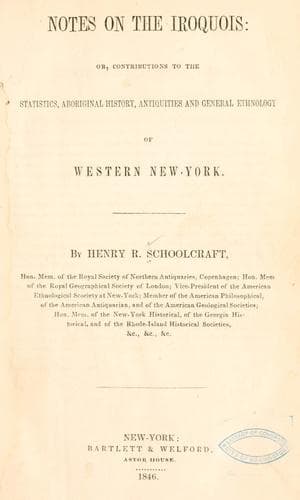
Notes on the Iroquois: or, Contributions to the Statistics, Aboriginal History, Antiquities and General Ethnology of Western New-YorkSchoolcraft, Henry Rowe
History
Notes on the Iroquois: or, Contributions to the Statistics, Aboriginal History, Antiquities and General Ethnology of Western New-York
Schoolcraft, Henry Rowe
Indians of North America -- New York (State); Iroquois Indians
It does not appear, from any thing history or tradition tells us, or
from any monumental remains in the valley or its immediate vicinity,
that it had before been occupied by other nations. They do not speak
of having driven out or conquered any other tribe. There are no old
forts or earthen walls, or other traces of military or defensive
occupancy, of which we have heard. Their ramparts were rather their
own brawny arms, stout bodies and brave hearts. From the earliest
notices of them, they were renowned for wielding the war club and
arrow with great dexterity. They raised corn on the rich intervales,
and pursued the deer, bear and elk in the subjacent forests. Their
dominion extended from the head waters of the Susquehanna and Delaware
to Lake Champlain. They had pursued their forays into the territorial
area of New-England, as far, at least, as the central portions of the
Connecticut, and had made their power felt, as temporary invaders,
among the small independent tribes who lived about the region of the
present city and harbor of New-York. Wherever they went, they carried
terror. Their very name, as we learn from Colden, was a synonyme for
cruelty and dread.[25] No tribe, perhaps, on the continent, produced
better warriors, or have ever more fully realized, as a nation, the
highest measure of heroism and military glory to which hunter nations
can reach.
[25] The word Mohawk itself, is not a term of Mohawk origin, but one
imposed upon them, as is believed, by the Mohegan race, who inhabited
the borders of the sea. Among this race the Dutch and English landed,
and they would naturally adopt the term most in vogue for so celebrated
a tribe. The Dutch, indeed, modified it to Maaquas—a modification
which helps us to decypher its probable origin, in Mauqua (by kindred
tribes, Mukwa, &c.) a bear. By others, it may be traced to mok, wa, a
wolf, and awki, a country.
In passing over the country which they once occupied, there is little
to stimulate historical interest, beyond the general idea of their
power and military renown. Their history is connected with the rise and
influence of one of our most distinguished anti-revolutionary citizens,
Sir William Johnson. The influence he obtained over them was never
exceeded, if equalled by that of any other man of European lineage.
He moulded them to his purposes in peace and war. They followed him
in his most perilous expeditions, and sustained him manfully, as we
know, in the two great contests to whose successful issue he owed his
laurels, namely, Lake George and Niagara. So completely identified
were they in feeling and policy with this politic and brave man, that
after his death, which happened at the crisis of ’76, they transferred
their attachment to his family, and staking their all on the issue,
abandoned their beloved valley and the bones of their fathers, and fled
to the less hospitable latitudes of Canada, from which they have never
permanently returned.
Public-domain text, read in full here on John Shaqi.
Reviews
Reviews
No reviews yet
Be the first to share your thoughts on this work.
Join the Discussion
Join the discussion
Sign in to leave a comment or review.
Sign InorCreate an account