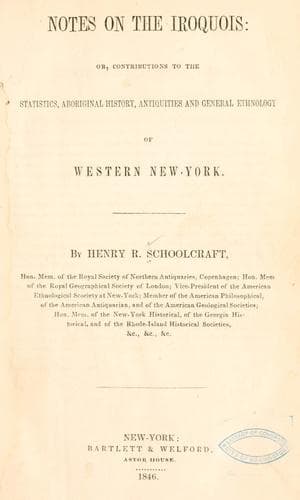
Notes on the Iroquois: or, Contributions to the Statistics, Aboriginal History, Antiquities and General Ethnology of Western New-YorkSchoolcraft, Henry Rowe
History
Notes on the Iroquois: or, Contributions to the Statistics, Aboriginal History, Antiquities and General Ethnology of Western New-York
Schoolcraft, Henry Rowe
Indians of North America -- New York (State); Iroquois Indians
It was observable that the encrinites contained in this mass, were red.
My Indian guide would have this color to be the result of the ancient
Indian war paint. But the most striking characteristic of this rock,
aside from its massy and flattened size and channelled centre, consists
in the evidences it affords of the action of water, in rounding and
polishing it. In several places, my guide would have this wearing
effect to have been produced by the rubbing and sharpening of the
Indian war axes; for he averred that it was customary for war parties
who went out south against the Cherokees, to come and sharpen their
axes upon this stone, and paint themselves for war. Whatever there
was in this custom, I think he was probably mistaken in his locality;
yet it is a question in which others may differ. At any rate, geology
had been quite beforehand with the Oneida legendary and philosopher,
in producing and accounting for these two phenomena, namely, the
red color and smoothed and channelled surfaces. Geology having been
mentioned, I may add the following incident. I told Skanawadi, one
of my guides, while standing at the Oneida stone, lying on its proud
ancient elevation, that there was no stone like this, in place, till we
went north to the Adirondacks or Tehawas, or great lakes, and that this
block of syenite had been brought here by the ocean, when it covered
the whole land, and left on its recession. He replied, after a moment’s
reflection, that “he believed this.”
At the time the Oneidas came to fix their location at this stone, the
Konoshioni or Iroquois had not confederated. This people, in the early
eras of their history, like the Algonquins, sent out individuals and
bands, who became powerful, and assumed the character of separate and
independent tribes, making war and peace ad libitum. If this mode of
multiplication be compared to the lower orders of creation, it had some
striking analogies with it. Like the bear and the hawk, the moment the
young member was ready to quit the parent lair or nest, it had not
only to forage for subsistence, but to defend itself against other
bears and hawks, and all other claimants to the food of the forest.
To make war is, in fact, the first and the last act of sovereignty of
the pettiest of all our aboriginal tribes. War is with them the road,
and the only road to fame, and the readiest way to secure a supply of
spontaneous food. They fight to increase or defend the boundaries of
their hunting grounds. Thus, doubtless, arose the first difficulties
between the Oneidas and the other branches of the Iroquois. As soon as
they were important enough to be noticed, and bold enough to defend
themselves, they had to raise barriers around their villages, and when
these were carried, as they probably were, or were threatened to be,
at two points, on the Oneida waters, they fled to the hill country, at
the site of the Oneida stone. How long they abode here, and made it the
Public-domain text, read in full here on John Shaqi.
Reviews
Reviews
No reviews yet
Be the first to share your thoughts on this work.
Join the Discussion
Join the discussion
Sign in to leave a comment or review.
Sign InorCreate an account