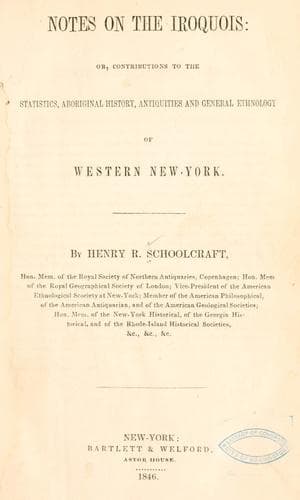
Notes on the Iroquois: or, Contributions to the Statistics, Aboriginal History, Antiquities and General Ethnology of Western New-YorkSchoolcraft, Henry Rowe
History
Notes on the Iroquois: or, Contributions to the Statistics, Aboriginal History, Antiquities and General Ethnology of Western New-York
Schoolcraft, Henry Rowe
Indians of North America -- New York (State); Iroquois Indians
seat of their council fire, we can only conjecture. They cannot and
do not pretend to tell. Wisdom, at length, taught the Iroquois sages,
that they had enemies enough, without fighting with each other, and the
idea of a confederation was suggested. Tradition has preserved the name
of Thaunowaga as the original suggester: but it has preserved nothing
more of his biography. The delegate from the Oneidas was Otatschechta.
That he came from, and lived at, the locality of the stone, and was
renowned for his deeds and wisdom, is probable. This comprises the
brief biography of two celebrated aboriginal sages and statesmen. Three
periods of transference, of their council fire, have been named, all
of which were probably prior to the confederation. Their fourth remove
was down the valley to the present site of Oneida Castle—a place which
then, as now, they called KUNAWALOA, meaning a man’s head on a pole.
At this place they lived and held their council fire, when the Dutch,
in 1609, discovered and ascended the Kohatatea, or, Hudson river.
Such are the accounts of their sachems and wise men. It is a general
confirmation of them, that the other members call them Younger Brother.
By another and older Indian tradition, an earlier date is assigned
to the Oneida canton, which is regarded as one of the original
subdivisions of the generic stock. It represents this stock as moving
from the west to the east, and at another period, returning towards the
point of sun-setting, leaving the several separate tribes, or cantons,
in their order as they passed. In this migration, the Oneidas are named
as the second in geographical position and order of chronology.
They located themselves, says the Tuscarora annalist,[30] at a
stream called Kaw nah taw te ruh, or Pineries, a tributary, of the
Susquehanna, which originates according to this authority, in Allen’s
lake, ten miles south of Oneida Castle. They were called Ne haw
retahgo,[31] or Big-Tree, a name, it may be remarked, which does not
occur as the patronymic for this tribe in other authors, nor has it
been retained by them. The distance and course denoted, coincide very
nearly with that of the Oneida stone. It is not known, however, that
any tributary of the Susquehanna exists in that vicinity.
[30] Cusick.
[31] In Tuscarora.
Public-domain text, read in full here on John Shaqi.
Reviews
Reviews
No reviews yet
Be the first to share your thoughts on this work.
Join the Discussion
Join the discussion
Sign in to leave a comment or review.
Sign InorCreate an account