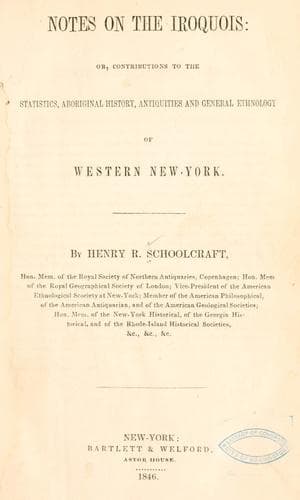
Notes on the Iroquois: or, Contributions to the Statistics, Aboriginal History, Antiquities and General Ethnology of Western New-York — John Shaqi
Notes on the Iroquois: or, Contributions to the Statistics, Aboriginal History, Antiquities and General Ethnology of Western New-YorkSchoolcraft, Henry Rowe
History
Notes on the Iroquois: or, Contributions to the Statistics, Aboriginal History, Antiquities and General Ethnology of Western New-York
Schoolcraft, Henry Rowe
Indians of North America -- New York (State); Iroquois Indians
II. The present being the first time[1] that a formal and full census
of a nation or tribe of Indians has been called for, with their
industrial efforts, by any American or European government exercising
authority on this continent, the principles and policy of the measure
presented a novel question to the Iroquois, and led to extended
discussions. As these discussions, in which the speakers evinced no
little aptitude, bring out some characteristic traits of the people, it
may be pertinent, and not out of place here, briefly to advert to them.
[1] It forms no contradiction to the precise terms of this remark, that
the Legislature of Virginia directed the numbering of the Powhatanic
tribes, within its boundaries, in 1788. Vide Jefferson’s Notes on
Virginia.
As a general fact, the policy of a census, and its beneficial bearings
on society, were not understood or admitted.[2] It seemed to these
ancient cantons to be an infringement on that independence of condition
which they still claim and ardently cherish. In truth, of all subjects
upon which these people have been called on to think and act, during
our proximity to them of two or three centuries, that of political
economy is decidedly the most foreign and least known to them, or
appreciated by them, and the census movement was, consequently, the
theme of no small number of suspicions and cavils and objections.
Without any certain or generally fixed grounds of objection, it was yet
the object of a fixed but changing opposition. If I might judge, from
the scope of remarks made both in and out of council, they regarded it
as the introduction of a Saxon feature into their institutions, which,
like a lever, by some process not apparent to them, was designed, in
its ultimate effects, to uplift and overturn them. And no small degree
of pith and irony was put forth against it by the eloquent respondents
who stood in the official attitude of their ancient orators.
Everywhere, the tribes exalted the question into one of national
moment. Grave and dignified sachems assembled in formal councils, and
indulged in long and fluent harangues to their people, as if the very
foundations of their ancient confederacy were about to be overturned
by an innovating spirit of political arithmetic and utilitarianism.
When their true views were made known, however, after many days and
adjourned councils, I found there was less objection to the mere
numbering of their tribes and families, than the [to them] scrutinizing
demand, which the act called for, into their agricultural products,
and the results of their industry. Pride also had some weight in the
matter. “We have but little,” said one of the chiefs, in a speech in
council, “to exhibit. Those who have yielded their assent, have their
barns well stored, and need not blush when you call.”
Public-domain text, read in full here on John Shaqi.
Reviews
Reviews
No reviews yet
Be the first to share your thoughts on this work.
Join the Discussion
Join the discussion
Sign in to leave a comment or review.
Sign InorCreate an account