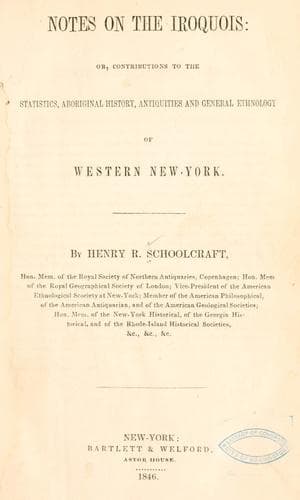
Notes on the Iroquois: or, Contributions to the Statistics, Aboriginal History, Antiquities and General Ethnology of Western New-YorkSchoolcraft, Henry Rowe
History
Notes on the Iroquois: or, Contributions to the Statistics, Aboriginal History, Antiquities and General Ethnology of Western New-York
Schoolcraft, Henry Rowe
Indians of North America -- New York (State); Iroquois Indians
[2] To this remark, the Tuscaroras, who met the subject at once, in
a frank and confidential manner, and the Onondagas, who appeared to
be governed therein by the counsels of a single educated chief, form
exceptions.
Another topic mixed itself with the consideration of the census,
and made some of the chiefs distrustful of it. I allude to the long
disturbed state of their land question, and the treaty of compromise
which has recently been made with the Ogden Company, by which the
reversionary right to the fee simple of two of their reservations has
been modified. In this compromise, the Tonewandas, a considerable
sub-tribe or departmental band of Senecas, did not unite; yet the
reservation which they occupy is one of the tracts to be given up.
They opposed the census, from the mere fear of committing themselves
on this prior question, in some way, not very well understood by them,
and certainly not well made out by their speakers. It is known that
for many years, the general question of ceding their reservations,
under the provisions of an early treaty of the State with the Six
Nations, had divided the Senecas into two parties. A discussion which
has extended through nearly half a century, in which Red Jacket had
exhibited all his eloquence, had sharpened the national acumen in
negotiation, and produced a peculiar sensitiveness and, suspicion of
motive, whenever, in latter times, the slightest question of interest
or policy has been introduced into their councils. This spirit evinced
itself in the very outset of my visit, on announcing to certain bands
the requirements of the census act. Some of them were, moreover,
strongly disposed to view it as the preliminary step, on the part
of the Legislature, to taxation. To be taxed, is an idea which the
Iroquois regard with horror. They had themselves, in ancient days, put
nations under tribute, and understood very well the import of a State
tax upon their property.
“Why,” said the Tonewanda chief, Deonehogawa, (called John Blacksmith,)
“why is this census asked for, at this time, when we are in a
straitened position with respect to our reservation? Or if it is
important to you or us, why was it not called for before? If you do not
wish to obtain facts about our lands and cattle, to tax us, what is the
object of the census? What is to be done with the information after you
take it to Governor Wright, at Skenectati?”[3]
[3] The aborigines are very tenacious of their geographical names. This
ancient name of the seat of government I found to be used, on every
occasion, among the Senecas, when it was necessary to allude to Albany.
Its transference on the conquest of the province, in 1664, to the banks
of the Mohawk, in lieu of the aboriginal name of _Onigarawantel_, never
received, at least, their sanction.
Public-domain text, read in full here on John Shaqi.
Reviews
Reviews
No reviews yet
Be the first to share your thoughts on this work.
Join the Discussion
Join the discussion
Sign in to leave a comment or review.
Sign InorCreate an account