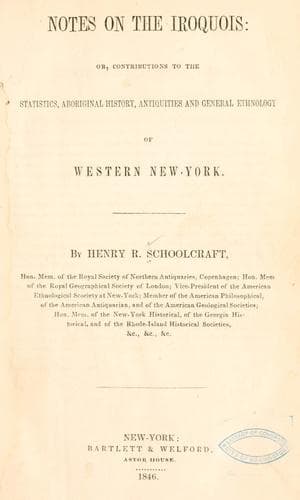
Notes on the Iroquois: or, Contributions to the Statistics, Aboriginal History, Antiquities and General Ethnology of Western New-YorkSchoolcraft, Henry Rowe
History
Notes on the Iroquois: or, Contributions to the Statistics, Aboriginal History, Antiquities and General Ethnology of Western New-York
Schoolcraft, Henry Rowe
Indians of North America -- New York (State); Iroquois Indians
If it be inquired why this people, with so comparatively small a
population, carried their wars to such an extent, and acquired,
probably in no great time, so wide a sway and power over the other
tribes of the continent, the reply will appear, in a great measure, in
this efficient war organization. It may be said that other tribes had
the same principles. But these eastern and western tribes had feeble
or divided counsels. Each tribe was a sovereignty by itself, and their
powers were tasked by home wars, without attempts at remote conquest.
There is nothing to denote that the number of war chiefs was ever
settled or fixed. Time and chance determined this, as we observe it in
the Algonquin and other American stocks. Fixity, in the number of the
civil chiefs, was indeed rather a theory than an actuality, and the
number must have been perpetually fluctuating, according to obvious
circumstances.
But while the theory of the Iroquois government thus distributed
its powers between two classes of chiefs, one of which ruled in the
council, and the other in the field, there was a third power of
controlling influence in both, which respected, it is true, this
ancient theory, but which annulled, confirmed, originated, or set
aside all other power. I allude to the popular will as exercised by
the warriors. Whatever was proposed had to come under the voice of
the armed men, who had the free right, at all times, to assemble in
council, and put their approval or veto on every measure. Practically
considered, a purer democracy, perhaps, never existed. The chiefs
themselves had no power in advance of public sentiment, or else it was
their policy, as we see it at this day, to express no such power, but
rather to keep in abeyance of, or be the mere agents of the popular
will. In all negociations such absolute power is disclaimed by them.
Acting on principles of the highest diplomacy, they invariably defer
general answers, until a reference can be had to the warriors or men.
They risk nothing by taking grounds in doubtful positions in advance,
and the consequence is that the results of most Indian councils are
unanimous.
Public-domain text, read in full here on John Shaqi.
Reviews
Reviews
No reviews yet
Be the first to share your thoughts on this work.
Elsewhere in the archive
Join the Discussion
Join the discussion
Sign in to leave a comment or review.
Sign InorCreate an account