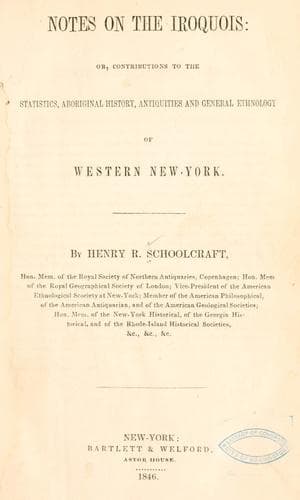
Notes on the Iroquois: or, Contributions to the Statistics, Aboriginal History, Antiquities and General Ethnology of Western New-YorkSchoolcraft, Henry Rowe
History
Notes on the Iroquois: or, Contributions to the Statistics, Aboriginal History, Antiquities and General Ethnology of Western New-York
Schoolcraft, Henry Rowe
Indians of North America -- New York (State); Iroquois Indians
There was yet a reserved power in the Iroquois councils which deserves
to be mentioned. I allude to the power of the matrons. This was an
acknowledged power of a conservative character, which might, at all
times, be brought into requisition, whenever policy required it. And
it exists to-day as incontestibly as it did centuries ago. They were
entrusted with the power to propose a cessation of arms. They were
literally peace-makers. A proposition from the matrons to drop the war
club could be made without compromitting the character of the tribe for
bravery; and accordingly, we find, in the ancient organization, that
there was a male functionary, an acknowledged speaker, who was called
the representative or messenger of the matrons. These matrons sat in
council, but it must needs have been seldom that a female possessed
the kind of eloquence suitable to public assemblies; and beyond this
there was a sentiment of respect due to the female class, which led the
tribes, at their general organization, to create this office.
Councils, so organized—so perpetually and truly swayed by popular
will, gave the greatest scope for eloquence. Eloquence, in the
aborigines, takes the place entirely of books and letters. It is
the only means of acting on the multitude, and we find that it was,
from the earliest times, strenuously and successfully cultivated by
the Iroquois. By far the best and most abundant specimens of native
eloquence we possess are from this stock. And their history is replete
in proofs that they employed it, not only in their internal affairs
and negociations, but in teaching to appreciate their rights and the
principles of their government.
[_d._] Ancient Worship.
SACRED FIRE.—THE SUN A SYMBOL OF DIVINE INTELLIGENCE.
It was a striking peculiarity of the ancient religious system of the
Iroquois that, once a year, the priesthood supplied the people with
sacred fire. For this purpose, a set time was announced for the ruling
priest’s visit. The entire village was apprized of this visit, and
the master of each lodge was expected to be prepared for this annual
rite. Preliminary to the visit, his lodge fire was carefully put out
and ashes scattered about it, as a symbolic sign of desolation and
want. Deprived of this element, they were also deprived of its symbolic
influence, the sustaining aid and countenance of the supreme power,
whose image they recognized in the sun.
It was to relieve this want, and excite hope and animation in breasts
which had throbbed with dread, that the priest visited the lodge.
Exhibiting the insignia of the sacerdotal office, he proceeded to
invoke the Master of Life in their behalf, and ended his mission by
striking fire from the flint, or from percussion, and lighting anew
the domestic fire. The lodge was then swept and garnished anew, and a
feast succeeded.
Public-domain text, read in full here on John Shaqi.
Reviews
Reviews
No reviews yet
Be the first to share your thoughts on this work.
Elsewhere in the archive
Join the Discussion
Join the discussion
Sign in to leave a comment or review.
Sign InorCreate an account