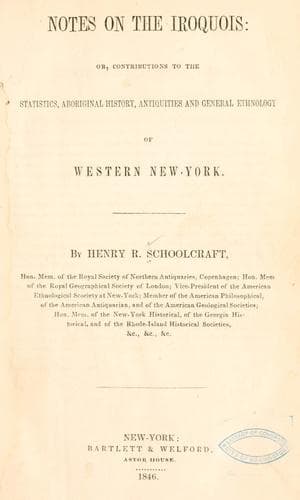
Notes on the Iroquois: or, Contributions to the Statistics, Aboriginal History, Antiquities and General Ethnology of Western New-YorkSchoolcraft, Henry Rowe
History
Notes on the Iroquois: or, Contributions to the Statistics, Aboriginal History, Antiquities and General Ethnology of Western New-York
Schoolcraft, Henry Rowe
Indians of North America -- New York (State); Iroquois Indians
This sacred service annually performed, had the effect to fix and
increase the reverence of the people for the priestly office. It acted
as a renewal of their ecclesiastical fealty; and the consequence was,
that the institution of the priesthood among these cantons was deeply
and firmly seated. Whether this rite had any connection with the
period of the solstices, or with the commencement of the lunar year,
is not known, but is highly probable. That men living in the open air,
who are regardful of the celestial phenomena, should not have noted
the equinoxes, is not probable. They must have necessarily known the
equinoxes by the observation of capes and mountains, which cast their
shadows from points and describe angles so very diverse at the periods
of the sun’s greatest recession, or return. Yet we know not that the
time of such extreme withdrawal and return marked and completed the
circle of the year. Their year was, in all the Algonquin tribes, a
lunar year. It consisted of thirteen moons, each of which is distinctly
named. Thirteen moons of 28 days each, counting from visible phase to
phase, make a year of 364 days, which is the greatest astronomical
accuracy reached by the North American tribes.
That the close of the lunar series should have been the period of
putting out the fire, and the beginning of the next, the time of
relumination, from new fire, is so consonant to analogy in the tropical
tribes, as to be probable.
The rite itself offers a striking coincidence, with that solemn
performance at the close of each year, by the Aztec priests, in the
valley of Mexico, and may not unreasonably be supposed to denote a
common origin for the belief. The northern tribes had, however, dropped
from the ritual, if it ever was in it, that of their remote ancestors,
the horrid rite so revolting in the Aztec annals, of _human sacrifice_.
For although prisoners were burned at the stake, this was not an act
of the priesthood. It was a purely popular effervescence of revenge
for losses of friends in war, or some other acts done by the enemy.
Such sacrifices appeased the popular cry—all classes, young and old,
rejoiced in them. They were looked on alone as an evidence of their
nation’s power; and by it the warriors also shewed their regard for
the relations of the bereaved. The widow of the warrior dried her
tears. The children rejoiced—they hardly knew why—it was the triumph
of the nation. And they were thus educated to regard the public burning
of prisoners as a proper and glorious deed. Women, indeed, rejoiced in
it apparently more than men. It seemed a solace for the loss of their
progeny. And all authors agree in attributing to the older females the
most extravagant and repulsive acts of participation and rejoicing in
these warlike rites.
[_e._] Witchcraft.
Public-domain text, read in full here on John Shaqi.
Reviews
Reviews
No reviews yet
Be the first to share your thoughts on this work.
Elsewhere in the archive
Join the Discussion
Join the discussion
Sign in to leave a comment or review.
Sign InorCreate an account