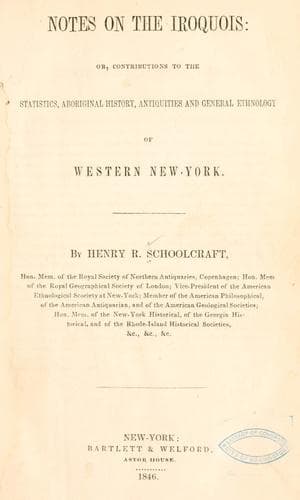
Notes on the Iroquois: or, Contributions to the Statistics, Aboriginal History, Antiquities and General Ethnology of Western New-YorkSchoolcraft, Henry Rowe
History
Notes on the Iroquois: or, Contributions to the Statistics, Aboriginal History, Antiquities and General Ethnology of Western New-York
Schoolcraft, Henry Rowe
Indians of North America -- New York (State); Iroquois Indians
The belief in witchcraft prevailed extensively among the North American
tribes. It is known that even in modern times, it was one of the
principal means used by the Shawnee prophet to rid himself of his
opponents, and that the venerable Shawnee chief Tarhe and others were
sacrificed to this diabolical spirit.
Among the Iroquois the belief was universal, and its effects upon their
prosperity and population, if tradition is to be credited, were at
times appalling. The theory of the popular belief, as it existed in
the several cantons, was this. The witches and wizzards constituted a
secret association, which met at night to consult on mischief, and each
was bound to inviolable secrecy. They say this fraternity first arose
among the Nanticokes. A witch or wizzard had power to turn into a fox
or wolf, and run very swift, emitting flashes of light. They could also
transform themselves into a turkey or big owl, and fly very fast. If
detected, or hotly pursued, they could change into a stone or rotten
log. They sought carefully to procure the poison of snakes or poisonous
roots, to effect their purposes. They could blow hairs or worms into a
person. [D.]
While in Onondaga, James Gould, one of the original settlers on the
Military Tract, told me that he had been intimate with Webster, the
naturalized Onondaga, who told him many things respecting the ancient
laws and customs of this people. Amongst them there was a curious
reminiscence on the subject of witchcraft. Webster had heard this from
an aged Onondaga, whom he conversed with during a visit which he once
made to Canada. This Onondaga said that he had formerly lived near the
old church on the Kasonda creek, near Jamesville, where there was in
old times a populous Indian village. One evening, he said, whilst he
lived there, he stepped out of his lodge, and immediately sank in the
earth, and found himself in a large room, surrounded by three hundred
witches and wizzards. Next morning he went to the council and told the
chiefs of this extraordinary occurrence. They asked him whether he
could not identify the persons. He said he could. They then accompanied
him on a visit to all the lodges, where he pointed out _this_ and
_that_ one, who were marked for execution. Before this inquiry was
ended, a very large number of persons of both sexes were killed. He
said ——[55] hundred.
[55] Having doubts, I omit to fill this blank.
Another tradition says that about fifty persons were burned to death at
the Onondaga castle for witches. [D.]
The delusion prevailed among all the cantons. The last persons executed
for witchcraft among the Oneidas, suffered about forty years ago.
They were two females. The executioner was the notorious Hon Yost of
revolutionary memory. He entered the lodge, according to a prior decree
of the Council, and struck them down with a tomahawk. One was found in
the lodge; the other suffered near the lodge door. [B.]
[_f._] Wife’s Right to Property.
Public-domain text, read in full here on John Shaqi.
Reviews
Reviews
No reviews yet
Be the first to share your thoughts on this work.
Elsewhere in the archive
Join the Discussion
Join the discussion
Sign in to leave a comment or review.
Sign InorCreate an account