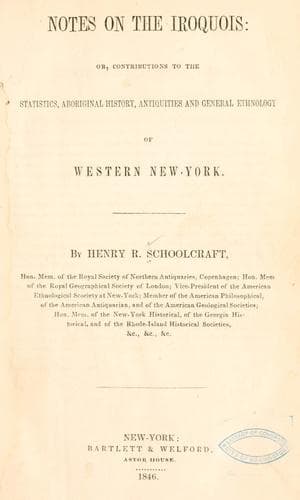
Notes on the Iroquois: or, Contributions to the Statistics, Aboriginal History, Antiquities and General Ethnology of Western New-YorkSchoolcraft, Henry Rowe
History
Notes on the Iroquois: or, Contributions to the Statistics, Aboriginal History, Antiquities and General Ethnology of Western New-York
Schoolcraft, Henry Rowe
Indians of North America -- New York (State); Iroquois Indians
During this year De Traci came out as viceroy of New-France, and
the same year Monsieur Coursel, who is notorious for his perfidy in
executing the Iroquois sachem, Agariata, arrived with the commission
of Governor-General of Canada. But there is little to be found bearing
directly on the subject before us.
It would appear from the journal of the Jesuit, Father Le Moyne, as
given in the missionary “Relacions,” that the country of the Onondagas
was not discovered and explored until the year 1653. Facts disclosed
by him in the same letter denote, however, prior negociations with
the French authorities, and we are probably to understand only that
as yet, no missionaries from his or any other order, had visited,
or been established amongst this tribe. In this view, and from the
incidental light which he throws on some other topics, such as the
new breaking out of the war with the Eries, the discovery of the salt
springs, and the existence of the buffalo in the country, this letter
is important to the early Iroquois history, and a translation of it is
hereto appended. It is certain that no mission or fort had then been
introduced. A footing may, however, have been gained by the French
within the next fourteen years, that is, at the time of the apparent
date of the existence of the old fort on the right banks of the
Kasonda.[60]
[60] Fire-arms began to be first introduced among the Iroquois in 1609,
the very year that Hudson explored the river now bearing his name. In
this year, Champlain, heading the Algonquins, with some regular troops,
in lake Corlear, (since called Champlain,) defeated the Mohawks by the
use of fire-arms.
Where history fails, we may appeal to tradition and to the proofs
drawn from antiquarian remains. Isaac Keeler, who is above mentioned,
exhibited to me one-half of the brass circle of a dial plate, three
inches (less two-tenths) in diameter, which had been ploughed up by
him on the site of the fort, or from that general area. This circle
had engraved, in good Roman characters, the numbers II, III, IV, V,
VI, VII, VIII. He likewise exhibited the box of a small brass pocket
compass, with a screw lid one inch and two-tenths in diameter. From
this instrument the needle had been removed and its place supplied by
vermillion, the highly prized war pigment of the Indians. When plowed
up and found at the bottom of a furrow, it was encrusted with oxide,
but restored by washing and friction to its original color and even
surface. On being opened, it was found to contain the pigment, of
which I examined a portion. It appeared to me to have been, not the
Chinese vermillion of the trade, but the duller red article, which is,
I believe, a peroxide of lead prepared by the Dutch.
Among the articles which he had preserved were the following:
1. A crucifix of brass of two inches in length, ornamented by a human
figure, and having a metallic loop for suspending it.
Public-domain text, read in full here on John Shaqi.
Reviews
Reviews
No reviews yet
Be the first to share your thoughts on this work.
Elsewhere in the archive
Join the Discussion
Join the discussion
Sign in to leave a comment or review.
Sign InorCreate an account