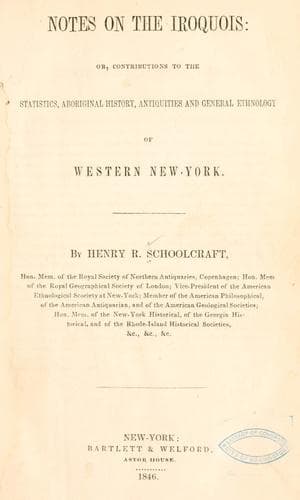
Notes on the Iroquois: or, Contributions to the Statistics, Aboriginal History, Antiquities and General Ethnology of Western New-YorkSchoolcraft, Henry Rowe
History
Notes on the Iroquois: or, Contributions to the Statistics, Aboriginal History, Antiquities and General Ethnology of Western New-York
Schoolcraft, Henry Rowe
Indians of North America -- New York (State); Iroquois Indians
2. An octagonal medal, four-tenths of an inch, of the same material,
bearing a figure with the name “St. Agatha,” and the Latin word
“ora”—a part of the Gregorian chant.
3. A similar medal, five-tenths of an inch in length, with a figure,
inscribed “St. Lucia,” and the same fragment of a chant.
4. A rude medal of lead, an inch and four-tenths long, ovate, with the
figure of the Savior, as is supposed, being that of a person suspended
by the outstretched hands, however, and the figure of a serpent, as if
this form of temptation had been presented during his advent. On the
reverse, is a sitting figure, which bears most resemblance to a common
and characteristic position of one of the native priests or prophets.
Should this conjecture be correct, this figure may have been intended,
adopting the Indian method, to teach the office of the Savior by a
symbol. He is thus shown, however, to be merely the priest and prophet
of men—an idea which does not coincide with Catholic theology, and
which, if not enlarged and corrected by verbal teaching, would convey
no conception of his divine character and atonement, and thus leave
the Onondaga neophyte as essentially in the dark as before. To figure
the Savior as the great Jesukeed of men, as is done in this medal, is
indeed the most extraordinary and audacious act of which the history of
missions among rude nations affords any parallel. The novelty of this
feature in this apparently home-wrought model, gives it a claim to be
hereafter figured.
5. An iron horse-shoe, four and a half inches long nearly, and five
inches, lacking two-tenths, broad, with three elongated nail holes in
each side, and a clumsy steel cork, partially worn. The peculiar fabric
of this shoe, its clumsiness and spread, and the little mechanical
skill which it evinces in the hammering and general make, denote it to
be very clearly the workmanship of a Canadian blacksmith, such as a
rude Canadian blacksmith is still to be witnessed, in the lake country,
and to have been, at the same time, intended for the unfarriered hoofs
of the Canadian horse.
6. A pair of iron strap hinges, common and coarse. These my informant
had turned to account, by employing them to hang the little gate which
led, through a small flower plat, to his dwelling house. See figure F.
These articles have been selected for notice from many of more common
occurrence, such as beads of coarse paste, enamel and glass, of various
sizes and colors, which are evidently of European make. My informant
further stated that a blacksmith’s anvil, vice, horn, and almost every
other article of a smith’s shop, had been from time to time found on
the site or in the vicinity, but there was nothing of this kind in his
possession. On the south declivity of the hill, near the present road
leading east to Pompey hill, there is a spring still sheltered with
shrubbery, which he supposes furnished the fort with water.
Public-domain text, read in full here on John Shaqi.
Reviews
Reviews
No reviews yet
Be the first to share your thoughts on this work.
Elsewhere in the archive
Join the Discussion
Join the discussion
Sign in to leave a comment or review.
Sign InorCreate an account