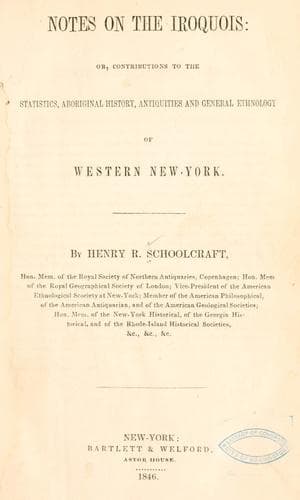
Notes on the Iroquois: or, Contributions to the Statistics, Aboriginal History, Antiquities and General Ethnology of Western New-YorkSchoolcraft, Henry Rowe
History
Notes on the Iroquois: or, Contributions to the Statistics, Aboriginal History, Antiquities and General Ethnology of Western New-York
Schoolcraft, Henry Rowe
Indians of North America -- New York (State); Iroquois Indians
description. [See appendix.] But the most remarkable and distinctive
trait connected with its archæology is the discovery of human bones
denoting an uncommon stature and development, which are mentioned in
the same communication. A humerus or shoulder bone, which is preserved,
denotes a stature one-third larger than the present race, and there is
also a lower jaw bone, preserved by a physician at Batavia, from the
vicinity, which indicates the same gigantic measure of increase.
[66] I find the French word casse-tete more exactly descriptive of the
probable and exclusive uses of the antique stone tomahawk, than any
other which has been met with. The shape of this warlike instrument
resembled strongly the ancient crossbill. It presents the figure of
a crescent, tapering gradually to the ends, which are rounded, and
proceed to a sharp point. In the concave centre of the crescent is
an orifice for a helve. It is an instrument denoting skill, and the
possession of some mechanical tool for carving it harder than the
dark silecious slate, from which it is generally made. One of these
instruments, sent to me by Mr. Follet, of Batavia, and which, from an
inscription, was found “in that vicinity by Jerome A. Clark, Esq. on
the 16th May, 1844,” is worthy the chisel of a sculptor.
To supply the fort with water, a trench was continued about fifteen
rods, from B at the northeast angle to E, in order to reach a spring
below the declivity. In the isolated portion of the hill, marked F.
haiks of moderate sized round stones have been found, which were
probably one of the ancient means of defence. This spot, from the
remains found, appears also to have been an ancient place of burial.
Among the articles exhumed, were several curious pipes of stone and
earthenware. One of these was formed out of granular limestone; another
was of baked clay in the form of a man’s head and face, the nose, eyes
and other features being depicted in a style resembling some of the
figures in Mr. Stephens’ plates of the ruins of Central America. The
top of the head is surrounded by a fillet; on the occipital part are
also two fillets. The neck has a similar ornament, and there is another
on the breast. The orifices of the ears are denoted, and the whole
evinces no little degree of art. This is the most curious relic found.
Another pipe of reddish baked clay is ornamented with dots; two rows of
which extend round it, and another in festoons, like a chain looped up.
Public-domain text, read in full here on John Shaqi.
Reviews
Reviews
No reviews yet
Be the first to share your thoughts on this work.
Elsewhere in the archive
Join the Discussion
Join the discussion
Sign in to leave a comment or review.
Sign InorCreate an account