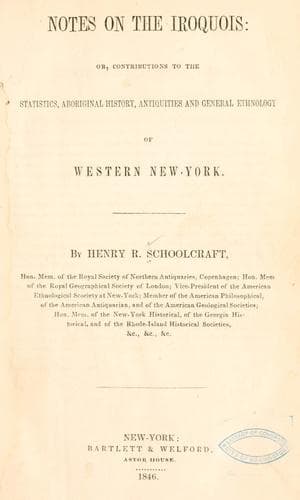
Notes on the Iroquois: or, Contributions to the Statistics, Aboriginal History, Antiquities and General Ethnology of Western New-YorkSchoolcraft, Henry Rowe
History
Notes on the Iroquois: or, Contributions to the Statistics, Aboriginal History, Antiquities and General Ethnology of Western New-York
Schoolcraft, Henry Rowe
Indians of North America -- New York (State); Iroquois Indians
Other parts of the topography are denoted by the plot. Q, W, is Allen’s
creek. H, I, K, Fordham’s brook. L, P, M, a branch of Fordham’s brook.
R, N, V, denote the road, which passes through the centre of the work.
A former road led from U down the ravine to T. There was formerly a
bridge at N, to cross the ditch. This trench was estimated by early
observers at from eight to ten feet deep, and as many wide. The earth
in making it, had been thrown either way, but much of it inwards.
Forest trees were standing, both in the trench and on its sides. In
size and age they appeared to be equal to the general growth of the
forest. Prostrate upon the ground, there were found numerous trunks
of the heart-wood of black cherry trees of large size. These were
evidently the remains of a more antique forest, which had preceded
the existing growth of beech and maple. They were in such a state of
soundness as to be employed for timber by the first settlers.
There were no traditions among the Indians of the country respecting
the use and design of this work. It was to them, as to the first
settlers, an object of mystery. About half a mile below the hill,
Allen’s creek has a fall of some eighty feet. It is a perpendicular
fall of much beauty. At this place the hydraulic limestone is seen to
be the underlying rock. This rock had also been struck in excavating
the north line of the trench, on “Fort Hill,” and some portions of it
had been thrown out with the earth.
Such are the interesting facts communicated to me, by the gentlemen
whose names have been mentioned. The notice of the present altered
state of the site, and the following just reflections naturally
springing from the subject, may be stated in the exact words of Dr.
Dewey:
“The forest has been removed. Not a tree remains on the quadrangle, and
only a few on the edge of the ravine on the west. By cultivating the
land, the trench is nearly filled in some places, though the line of
it is clearly seen. On the north side the trench is considerable, and
where the road crosses it, is three or four feet deep at the sides of
the road. It will take only a few years more to obliterate it entirely,
as not even a stump remains to mark out its line.
“From this view it may be seen or inferred,
“1. That a real trench bounded three sides of the quadrangle. On the
south side there was not found any trace of trench, palisadoes, blocks,
&c.
“2. It was formed long before the whites came into the country. The
large trees on the ground and in the trench, carry us back to an early
era.
“3. The workers must have had some convenient tools for excavation.
“4. The direction of the sides may have had some reference to the four
cardinal points, though the situation of the ravines naturally marked
out the lines.
Public-domain text, read in full here on John Shaqi.
Reviews
Reviews
No reviews yet
Be the first to share your thoughts on this work.
Elsewhere in the archive
Join the Discussion
Join the discussion
Sign in to leave a comment or review.
Sign InorCreate an account