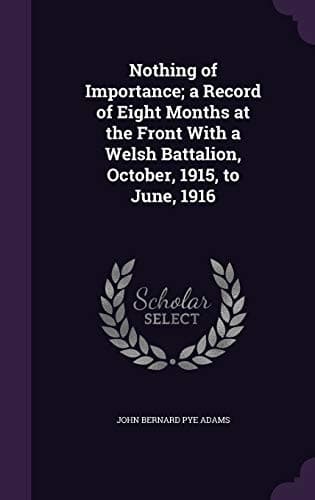
Nothing of Importance: A record of eight months at the front with a Welsh battalion, October, 1915, to June, 1916 — John Shaqi
Nothing of Importance: A record of eight months at the front with a Welsh battalion, October, 1915, to June, 1916Adams, Bernard
History
Nothing of Importance: A record of eight months at the front with a Welsh battalion, October, 1915, to June, 1916
Adams, Bernard
World War, 1914-1918 -- Personal narratives, English
I often wonder if these peasants think much. Think they must have done
at the beginning, when their men were hastily called up. But now, after
fifteen months of war? It is the children, chiefly, who are interested
in the aeroplanes, shining like eagles silver-white against the blue
sky; or in the boom from the battery across the street. But for their
mothers and grandparents these things have settled into their lives;
they are all one with the canal and the poplar trees. If a squad starts
drilling on their lettuces, they are tremendously alert; but as for
these other things, they are not interested, only unutterably tired of
them. And after awhile you adopt the same attitude. The noise of the
guns is boring and you hardly look up at an aeroplane, unless it is
shrapnelled by the ‘Archies’ (anti-aircraft guns); then it is worth
watching the pin-prick flashes dotting the sky all round it, leaving
little white curls of smoke floating in the blue.”
* * * * *
That billet was close to the firing-line. Here is a letter from a
village, eight miles back:
“20th Oct., 1915. We came out here on Monday. The whole division
marched out together. It was really an impressive sight, over a mile
of troops on the march. Perfect order, perfect arrangement. Where
the road bent you could often see the column for a mile in front, a
great snake curling along the right side of the road. Occasionally an
adjutant would break out of the line to trot back and correct some
straggling; or a C.O. would emerge for a gallop over the adjacent
ploughland.
Our company is billeted in a big prosperous farm. The men are in a
roomy barn and look very comfortable. We are in a big room, on the
right as you enter the front door of the farm: on a tiled floor stands
a round table with an oilcloth cover, originally of a bright red
pattern, but now subdued by constant scrubbings to the palest pink with
occasional scarlet dottings. There are big tall windows, a wardrobe
and sideboard, a big chimney-place fitted with a coke stove, and on
the walls hang three very dirty old prints. The only war touch (beside
our scattered possessions) is a picture from a French Illustrated of
_L’Assaut de Vermelles_. Outside is a yard animated by cows, turkeys,
geese, chicken, and ducks: also a donkey and a peacock, not to mention
the usual dogs and cats. At 5 a.m. I am awakened by an amazing chorus.
The ‘patron’ is a strong, competent man, with many fine buxom
daughters, who do the farm work with great capacity and energy.
Henriette with a pitchfork is strength and grace in action. Tommy is
much in awe of her. She hustles the pigs relentlessly. The sons are
at the war. Etienne and Marcelle, aged ten and eight respectively,
complete the family; with Madame, of course, who makes inimitable
coffee; and various grandparents who appear in white caps and cook and
bake all day.
Public-domain text, read in full here on John Shaqi.
Reviews
Reviews
No reviews yet
Be the first to share your thoughts on this work.
Join the Discussion
Join the discussion
Sign in to leave a comment or review.
Sign InorCreate an account