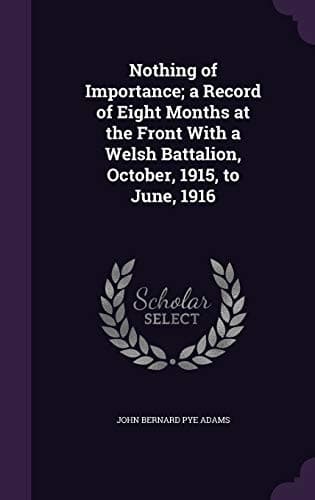
Nothing of Importance: A record of eight months at the front with a Welsh battalion, October, 1915, to June, 1916Adams, Bernard
History
Nothing of Importance: A record of eight months at the front with a Welsh battalion, October, 1915, to June, 1916
Adams, Bernard
World War, 1914-1918 -- Personal narratives, English
I have just ‘paid out’--all in five and twenty-franc notes. ‘In the
field’ every man has his own pay book which the officer must sign,
while the company quartermaster-sergeant sees that his acquittance
roll is also signed by Tommy. We had a small table and chair out in
the yard, and in an atmosphere of pigs and poultry I dealt out the
blue-and-white oblongs which have already in many cases been converted
into bread. For that is where most of the pay money goes, there and in
the _estaminets_. The bread ration is always small, the biscuit ration
overflowing. Bully beef, by the way, is simply ordinary corned beef. I
watched cooking operations yesterday, and saw some fifty tins cut in
half with an axe, clean hewn asunder, and the meat deftly hoicked with
a fork into the field-kitchen, or ‘cooker,’ which is a range and boiler
on wheels. This was converted into a big stew, and served out into
dixies (camp kettles) and so to the men’s canteens.
This afternoon our company practised an attack over open country. I
was surprised to find the men so well trained. I had imagined that
prolonged trench-warfare would have made them stale. The country is
_very_ flat. There are no hedges. The only un-English characteristics
are the poplar rows, the dried beans tied round poles like mother-gamp
umbrellas, and the wayside chapels and crucifixes.
Yesterday afternoon Edwards and I got in a little revolver practice
just near; and afterwards we had an energetic game of hockey, with
sticks and an empty cartridge-case.”
Altogether, billet life was very enjoyable. On November 1st Captain
Dixon joined our battalion and took over “B” Company. For over four
months I worked under the most good-natured and popular officer in the
battalion. We were always in good spirits while he was with us. “I
can’t think why it is,” he used to say, “I’m not at all a jolly person,
yet you fellows are always laughing; and in my old regiment it was
always the same!” He was a fearful pessimist, but a fine soldier. His
delight used to be to get a good fire blazing in billets, sit in front
of it with a novel, and then deliver a tirade against the discomfort
of war! The great occasion used to be when the arch-pessimist, our
quartermaster, was invited to dinner. Then Edwards, the Mess president,
would produce endless courses, and the two pessimists would warm to
a delightful duologue on the fatuity of the Staff, the Army, and the
Government.
“By Jove, we are the biggest fools on this earth!” Dixon would say at
last.
“We’re fools enough to be led by fools,” Jim Potter would reply.
And somehow we were all more cheerful than ever!
CHAPTER III
WORKING-PARTIES
“Fall in the brick-party.”
Public-domain text, read in full here on John Shaqi.
Reviews
Reviews
No reviews yet
Be the first to share your thoughts on this work.
Join the Discussion
Join the discussion
Sign in to leave a comment or review.
Sign InorCreate an account