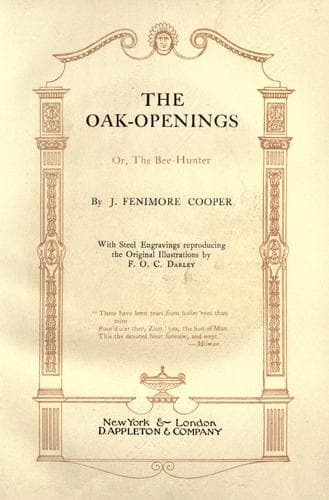
American fiction -- 19th century; Historical fiction; Indians of North America -- Fiction
At the customary hour, which was always early, in that party of simple
habits, the whole family sought its rest; the females withdrew within
the chiente, while the males arranged their skins without. Ever since
the erection of the palisades, le Bourdon had been in the habit of
calling Hive within the defences, leaving him at liberty to roam about
inside, at pleasure. Previously to this new arrangement, the dog had
been shut up in his kennel, in order to prevent his getting on the track
of a deer, or in close combat with some bear, when his master was not
present to profit by his efforts. As the palisades were too high for
his leap, this putting him at liberty within them answered the double
purpose of giving the mastiff room for healthful exercise, and of
possessing a most vigilant sentinel against dangers of all sorts. On the
present occasion, however, the dog was missing, and after calling and
whistling for him some time, the bee-hunter was fain to bar the gate,
and leave him on the outside. This done, he sought his skin, and was
soon asleep.
It was midnight, when the bee-hunter felt a hand laid on his own arm.
It was the corporal, making this movement, in order to awake him. In an
instant the young man was on his feet, with his rifle in his hand.
“Did you not hear it, Bourdon?” demanded the corporal, in a tone so low
as scarce to exceed a whisper.
“Hear what! I've been sleeping, sound as a bee in winter.”
“The horn!--The horn has been blown twice, and, I think, we shall soon
hear it again.”
“The horn was hanging at the door of the chiente, and the conch, too. It
will be easy to see if they are in their places.”
It was only necessary to walk around the walls of the hut, to its
opposite side, in order to ascertain this fact. Le Bourdon did so,
accompanied by the corporal, and just as each laid a hand on the
instruments, which were suspended in their proper places, a heavy rush
was made against the gate, as if to try its fastenings. These pushes
were repeated several times, with a violence that menaced the bars. Of
course, the two men stepped to the spot, a distance of only a few
paces, the gateway of the palisades and the door of the chiente being
contiguous to each other, and immediately ascertained that it was the
mastiff, endeavoring to force his way in. The bee-hunter admitted the
dog, which had been trained to suppress his bark, though this animal was
too brave and large to throw away his breath when he had better rely on
his force. Powerful animals, of this race, are seldom noisy, it being
the province of the cur, both among dogs and men, to be blustering and
spitting out their venom, at all hours and seasons. Hive, however, in
addition to his natural disposition, had been taught, from the time he
was a pup, not to betray his presence unnecessarily by a bark; and it
was seldom that his deep throat opened beneath the arches of the oaks.
When it did, it told like the roaring of the lion in the desert.
Public-domain text, read in full here on John Shaqi.
Reviews
Reviews
No reviews yet
Be the first to share your thoughts on this work.
Elsewhere in the archive
Join the Discussion
Join the discussion
Sign in to leave a comment or review.
Sign InorCreate an account