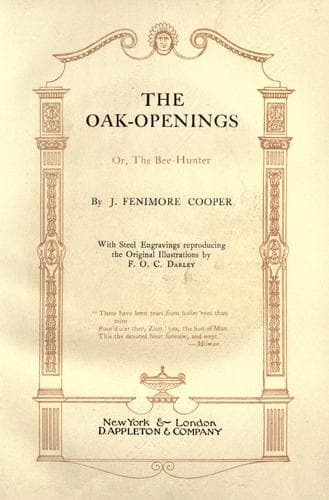
American fiction -- 19th century; Historical fiction; Indians of North America -- Fiction
The American forest has so often been described, as to cause one
to hesitate about reviving scenes that might possibly pall, and in
retouching pictures that have been so frequently painted as to be
familiar to every mind. But God created the woods, and the themes
bestowed by his bounty are inexhaustible. Even the ocean, with its
boundless waste of water, has been found to be rich in its various
beauties and marvels; and he who shall bury himself with us, once more,
in the virgin forests of this widespread land, may possibly discover new
subjects of admiration, new causes to adore the Being that has brought
all into existence, from the universe to its most minute particle.
The precise period of our legend was in the year 1812, and the season
of the year the pleasant month of July, which had now drawn near to its
close. The sun was already approaching the western limits of a wooded
view, when the actors in its opening scene must appear on a stage that
is worthy of a more particular description.
The region was, in one sense, wild, though it offered a picture that
was not without some of the strongest and most pleasing features of
civilization. The country was what is termed “rolling,” from some
fancied resemblance to the surface of the ocean, when it is just
undulating with a long “ground-swell.”
Although wooded, it was not, as the American forest is wont to grow,
with tail straight trees towering toward the light, but with intervals
between the low oaks that were scattered profusely over the view, and
with much of that air of negligence that one is apt to see in grounds
where art is made to assume the character of nature. The trees, with
very few exceptions, were what is called the “burr-oak,” a small
variety of a very extensive genus; and the spaces between them, always
irregular, and often of singular beauty, have obtained the name of
“openings”; the two terms combined giving their appellation to this
particular species of native forest, under the name of “Oak Openings.”
These woods, so peculiar to certain districts of country, are not
altogether without some variety, though possessing a general character
of sameness. The trees were of very uniform size, being little taller
than pear-trees, which they resemble a good deal in form; and having
trunks that rarely attain two feet in diameter. The variety is produced
by their distribution. In places they stand with a regularity resembling
that of an orchard; then, again, they are more scattered and less
formal, while wide breadths of the land are occasionally seen in which
they stand in copses, with vacant spaces, that bear no small affinity to
artificial lawns, being covered with verdure. The grasses are supposed
to be owing to the fires lighted periodically by the Indians in order to
clear their hunting-grounds.
Public-domain text, read in full here on John Shaqi.
Reviews
Reviews
No reviews yet
Be the first to share your thoughts on this work.
Join the Discussion
Join the discussion
Sign in to leave a comment or review.
Sign InorCreate an account