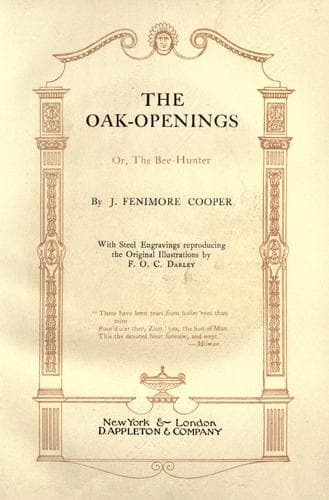
American fiction -- 19th century; Historical fiction; Indians of North America -- Fiction
Toward one of these grassy glades, which was spread on an almost
imperceptible acclivity, and which might have contained some fifty or
sixty acres of land, the reader is now requested to turn his eyes. Far
in the wilderness as was the spot, four men were there, and two of them
had even some of the appliances of civilization about them. The woods
around were the then unpeopled forest of Michigan; and the small winding
reach of placid water that was just visible in the distance, was an
elbow of the Kalamazoo, a beautiful little river that flows westward,
emptying its tribute into the vast expanse of Lake Michigan. Now, this
river has already become known, by its villages and farms, and railroads
and mills; but then, not a dwelling of more pretension than the wigwam
of the Indian, or an occasional shanty of some white adventurer,
had ever been seen on its banks. In that day, the whole of that fine
peninsula, with the exception of a narrow belt of country along the
Detroit River, which was settled by the French as far back as near the
close of the seventeenth century, was literally a wilderness. If a white
man found his way into it, it was as an Indian trader, a hunter, or an
adventurer in some other of the pursuits connected with border life and
the habits of the savages.
Of this last character were two of the men on the open glade just
mentioned, while their companions were of the race of the aborigines.
What is much more remarkable, the four were absolutely strangers to each
other's faces, having met for the first time in their lives, only an
hour previously to the commencement of our tale. By saying that they
were strangers to each other, we do not mean that the white men were
acquaintances, and the Indians strangers, but that neither of the four
had ever seen either of the party until they met on that grassy glade,
though fame had made them somewhat acquainted through their reputations.
At the moment when we desire to present this group to the imagination of
the reader, three of its number were grave and silent observers of
the movements of the fourth. The fourth individual was of middle size,
young, active, exceedingly well formed, and with a certain open
and frank expression of countenance, that rendered him at least
well-looking, though slightly marked with the small-pox. His real name
was Benjamin Boden, though he was extensively known throughout the
northwestern territories by the sobriquet of Ben Buzz--extensively as
to distances, if not as to people. By the voyageurs, and other French
of that region, he was almost universally styled le Bourdon or the
“Drone”; not, however, from his idleness or inactivity, but from the
circumstances that he was notorious for laying his hands on the
products of labor that proceeded from others. In a word, Ben Boden was
a “bee-hunter,” and as he was one of the first to exercise his craft in
that portion of the country, so was he infinitely the most skilful and
prosperous.
Public-domain text, read in full here on John Shaqi.
Reviews
Reviews
No reviews yet
Be the first to share your thoughts on this work.
Join the Discussion
Join the discussion
Sign in to leave a comment or review.
Sign InorCreate an account