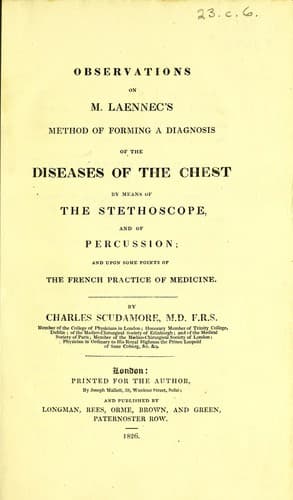
Observations on M. Laennec's method of forming a diagnosis of the diseases of the chest by means of the stethoscope, and of percussion; and upon some points of the French practice of medicine — John Shaqi
Observations on M. Laennec's method of forming a diagnosis of the diseases of the chest by means of the stethoscope, and of percussion; and upon some points of the French practice of medicineScudamore, Charles
Science
Observations on M. Laennec's method of forming a diagnosis of the diseases of the chest by means of the stethoscope, and of percussion; and upon some points of the French practice of medicine
Scudamore, Charles
Chest -- Diseases -- Diagnosis; Laennec, R. T. H. (René Théophile Hyacinthe), 1781-1826
In exploring the state of the chest with the stethoscope, it is
incumbent upon us to reason carefully upon every phenomenon which
we discover, and not to consider this or that circumstance as merely
curious. We should weigh well the importance of the pathological
indications; and form our conclusions, in great measure, from our
knowledge of the anatomical structure of the particular parts of the
organ which we find to be affected; and, also, from the relative
situation of one part to another. For example, we discover different
kinds of rattle, accordingly as the bronchial tubes, or the air
cells, may be respectively affected; and the effect produced on the
action of the heart by a morbid condensation of the left lung, is
very different from that occasioned by the same state of disease in
the right.
In cases of pulmonary consumption, it is important for us to
ascertain whether or not ulceration has yet taken place.
In this investigation, we use the stethoscope with its stopper, as
serving better to bring the sound of the voice to a focus. If there
be an open tubercle (in synonymous terms, ulceration, or excavation),
the vibrations produced by the voice passing more readily to the ear
of the auscultator, than when there is no breach of surface in the
lung, it seems as if the patient were speaking up the tube, and hence
the exact situation of the ulceration is indicated. This phenomenon
is called by the expressive term, pectoriloquism.
If the instrument be applied over the windpipe, when there is not
disease, the voice produces in some measure the same effect; because
at this part, the integuments are thin, and do not interpose much
medium between the voice of the person speaking, and the ear of the
auscultator.
It is a consoling circumstance that M. Laennec does not view
tubercular consumption as an incurable disease. He mentions having
several patients under his care ill with chronic catarrh, affording
distinctly the sign of pectoriloquism, although in all other respects
then free from symptoms of consumption.
He refers to the case of a lady, a patient of M. Bayle, in whom
pectoriloquism was quite distinct. She had been decidedly affected
with the symptoms of consumption eight years before: she had
recovered beyond all expectation, and was then stout, not having any
other symptom of pulmonary irritation than a slight cough.
M. Laennec next relates[2] the morbid appearances in the lungs,
found on dissection in five cases of patients who died from other
diseases. In each instance, tubercular excavations were found
cicatrized, and for the most part lined by a semi-cartilaginous
membrane; adding testimony therefore to the opinion already stated,
that nature does sometimes exert a curative process, in cases of
consumption which were apparently hopeless.
Public-domain text, read in full here on John Shaqi.
Reviews
Reviews
No reviews yet
Be the first to share your thoughts on this work.
Join the Discussion
Join the discussion
Sign in to leave a comment or review.
Sign InorCreate an account