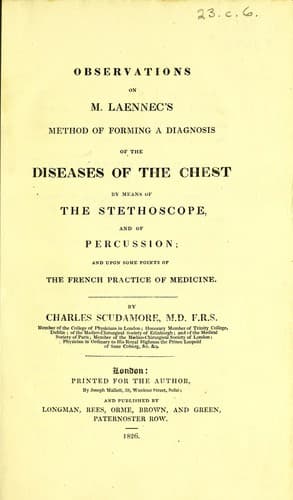
Observations on M. Laennec's method of forming a diagnosis of the diseases of the chest by means of the stethoscope, and of percussion; and upon some points of the French practice of medicineScudamore, Charles
Science
Observations on M. Laennec's method of forming a diagnosis of the diseases of the chest by means of the stethoscope, and of percussion; and upon some points of the French practice of medicine
Scudamore, Charles
Chest -- Diseases -- Diagnosis; Laennec, R. T. H. (René Théophile Hyacinthe), 1781-1826
Now, by means of the stethoscope, I distinguished to a considerable
extent at the upper part of the left side of the chest, a mixed
rattle, composed of sounds rather deep than acute, and a gurgling
noise, as if a large quantity of mucus was floating in the cells.
At the shoulder blade, the instrument furnished the same signs. In
addition to the repetition of bleeding from the arm, twenty ounces of
blood were removed by cupping, part from the breast and part from the
shoulder blade. Great and immediate relief was afforded. The general
fever, of which, both now and before, occasional delirium was one
symptom, was checked.
The medicine consisted of tartarized antimony and nitre in a saline
draught, with the addition of syrup of poppy, in order to quiet cough
and irritation. On the following day, blood was again taken from the
arm freely; but, notwithstanding the blood exhibited the same signs
as before in a great degree, no further depletion was required.
We are much instructed as to the degree of inflammatory action of
the vessels by the appearance of the blood, which, when possessing
these characters, is commonly, but inaccurately called inflamed. And
we must not consider that continued bleeding is the indispensable
remedy for restoring the circulation to a healthy state, and the
blood to its natural condition. My view of the nature of blood of
this description is, that it simply contains a larger proportion
than usual of one of its constituent parts, termed the fibrin; and
hence, a firmer clot and the buffy coat. It is important as being an
attendant on inflammatory action[1], and an indication, therefore, to
our treatment. Although we rightly attach all possible importance to
the use of the lancet, and of local bleeding, we must not forget that
we have other means of reducing the circulation; as, for example, the
use of medicines, repose, and general regimen.
To return to the case, I have to add, that when heat of the skin and
general fever were abated, the peculiar sounds just now mentioned,
had also nearly disappeared. In this state of improvement, a large
blister was applied over the affected side of the chest. As it
seemed probable that further general bleeding might be avoided,
digitalis was added to the medicine. This becomes a valuable agent
at the period when we may hope to have laid aside the use of the
lancet. If employed during the height of inflammation, most probably
it will not render the pulse slower; and even if it does have this
effect, it rather masks than cures the disease, leaving us in doubt
whether the abatement of the pulse be fairly due to the diminution
of inflammatory action, or to the influence of the digitalis. This
gentleman recovered gradually, but in the most favourable manner.
The latest morbid indication by the stethoscope, was simply the
mucous rattle.
Public-domain text, read in full here on John Shaqi.
Reviews
Reviews
No reviews yet
Be the first to share your thoughts on this work.
Join the Discussion
Join the discussion
Sign in to leave a comment or review.
Sign InorCreate an account