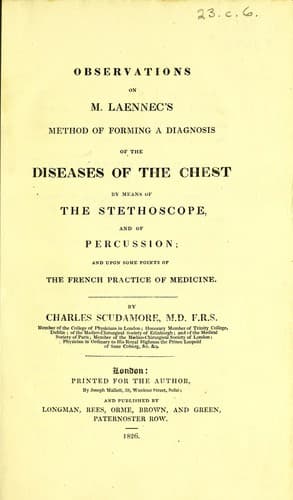
Observations on M. Laennec's method of forming a diagnosis of the diseases of the chest by means of the stethoscope, and of percussion; and upon some points of the French practice of medicineScudamore, Charles
Science
Observations on M. Laennec's method of forming a diagnosis of the diseases of the chest by means of the stethoscope, and of percussion; and upon some points of the French practice of medicine
Scudamore, Charles
Chest -- Diseases -- Diagnosis; Laennec, R. T. H. (René Théophile Hyacinthe), 1781-1826
I was consulted by a gentleman ill with gout, who related to me that,
a few years before, he had been troubled with intermittent pulse
for the long space of four years; and, during this period, his mind
was alarmed with many gloomy apprehensions. His digestive organs
were much disordered: medicine had given only partial relief. Quite
suddenly, a painful and regular fit of gout took place, for the first
time. Immediately the action of the heart became regular, and has so
continued from that period.
I have met with similar instances less strongly marked.
In various affections of the heart, and also of the aorta, I have
derived very useful information, and practical instruction, from
the employment of the stethoscope. In the case of a female, the
instrument, applied to the epigastric region, conveyed to the ear
the peculiar sound which is compared to the blast of a pair of
bellows strongly used, and which was attended with occasional pain,
especially after taking food. The repeated application of leeches,
with the use of sedative medicine, afforded permanent relief.
When we consider that, from the examination of the pulse at the
wrist, we obtain information only of the action of the left ventricle
of the heart, and that by means of the stethoscope we are made
acquainted with the action of both ventricles and both auricles, the
value of the instrument must appear unquestionable.
This fact, that the pulse at the wrist does not indicate the
state of the whole heart, is important in a practical as well as a
physiological point of view. The pulse, in certain diseases, may be
weak and small, when the action of the heart is energetic, and which
is to be ascertained by the stethoscope. On the other hand, there
may be more energy in the action of the pulse than in the heart
generally. The practitioner will receive very material instruction
with regard to the use of the lancet, in these indications; and
will know with more accuracy when he should prefer local to general
bleeding.
In the first trials with the stethoscope, it is extremely difficult
to distinguish the action of the ventricle from that of the auricle;
and this confusion is greater if the heart be acting with more than
ordinary frequency.
The motions of the left cavities of the heart are chiefly
perceptible in the space comprised between the cartilages of the
fifth and seventh ribs; and of the right, at about the middle of the
sternum, or sometimes rather lower.
Public-domain text, read in full here on John Shaqi.
Reviews
Reviews
No reviews yet
Be the first to share your thoughts on this work.
Join the Discussion
Join the discussion
Sign in to leave a comment or review.
Sign InorCreate an account