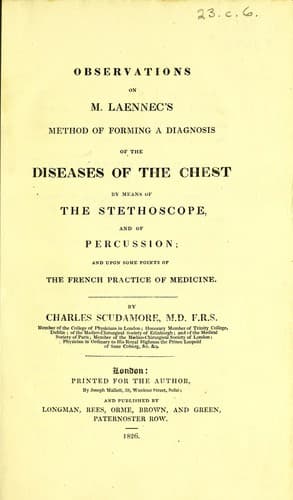
Observations on M. Laennec's method of forming a diagnosis of the diseases of the chest by means of the stethoscope, and of percussion; and upon some points of the French practice of medicineScudamore, Charles
Science
Observations on M. Laennec's method of forming a diagnosis of the diseases of the chest by means of the stethoscope, and of percussion; and upon some points of the French practice of medicine
Scudamore, Charles
Chest -- Diseases -- Diagnosis; Laennec, R. T. H. (René Théophile Hyacinthe), 1781-1826
With the stethoscope, we first distinguish the action of the
ventricles, which occurs at the same moment with the beat of the
pulse at the wrist. It is accompanied by a rather dull, but distinct
sound. Immediately after, and without any interval, the contraction
of the auricles takes place, attended with a noise which M. Laennec
compares to that of the lapping of a dog. The duration of this sound,
and consequently the period of the contraction of the auricles, is
less than that of the ventricles. Next, there is a very short, yet
well-marked, interval of repose.
The regularity of this order will be variously disturbed, by the
sympathy which the heart observes towards other organs, as I have
already explained; but much more materially by changes taking place
in its own structure.
The sounds occasioned by the action of the heart, or of the large
arteries, when disordered, are remarkably characteristic in their
nature, and, if well understood, assist in a very satisfactory
manner, our diagnosis, pathology, and treatment.
The Treatise of M. Laennec, and the late original publication by Dr.
Forbes, furnish us with much valuable information for the diagnostic
use of the stethoscope in diseases of the heart. A new volume which
is about to issue from the press, to be presented to us by the Master
of this art, M. Laennec, will contain the important results of his
later experience.
As, in a diseased condition of the lungs, when the symptoms are
more serious in appearance than reality, we can obtain the comfort
to the patient and ourselves, of giving a favourable prognosis by
means of the stethoscope; so, in the disordered action of the heart,
it may often be in our power to gain that clear perception of the
case, which may arm us with confidence as to its true nature, and
its freedom from danger, and thus enable us to dismiss much of the
apprehension, with which the nervous mind of the patient is sure to
be distressed.
Having thus brought in view an outline of the general merits of the
stethoscope[3], and of the improved method of exploring the diseases
of the chest, I proceed to the remainder of my subject; it being my
purpose to discuss, in a brief manner, some leading points of theory
and practice suggested to my consideration by the cases and facts
which came under my notice at the hospitals in Paris; and also to
offer a few observations on the most important new medicines which
may be considered of French origin.
GENERAL OBSERVATIONS.
Hospitals, and hospices, are numerous in Paris. The latter
establishments are for the reception of the aged and infirm, or
foundlings. Some of the hospitals are general in their principle of
administration; while others are appropriated to particular age, or
sex, or disease.
Public-domain text, read in full here on John Shaqi.
Reviews
Reviews
No reviews yet
Be the first to share your thoughts on this work.
Join the Discussion
Join the discussion
Sign in to leave a comment or review.
Sign InorCreate an account