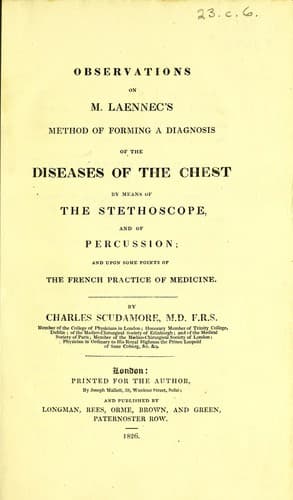
Observations on M. Laennec's method of forming a diagnosis of the diseases of the chest by means of the stethoscope, and of percussion; and upon some points of the French practice of medicineScudamore, Charles
Science
Observations on M. Laennec's method of forming a diagnosis of the diseases of the chest by means of the stethoscope, and of percussion; and upon some points of the French practice of medicine
Scudamore, Charles
Chest -- Diseases -- Diagnosis; Laennec, R. T. H. (René Théophile Hyacinthe), 1781-1826
That a material difference exists between the French and English
practice of medicine, is universally known; and the compliment of
superiority is seldom allowed to the former. Improvement, however, in
the art of medicine, which the successful cultivation of chemistry
and of morbid anatomy has so largely introduced in the last twenty
years, is not confined to ourselves. The professors of chemistry at
Paris receive their appointments and their conveniences from the
government. That valuable commodity, time, is much at their command,
because they confine their pursuits more than most of those who are
engaged in teaching chemistry in London. The facility of procuring,
at Paris, the examination of dead bodies is such as to favour the
study of morbid anatomy most completely.
The general objection amongst the French to the use of calomel
prevails almost as strongly as at former periods; and certainly
amounts to a prejudice. I learnt, on good authority, at Paris,
that this medicine is usually found to act in a peculiar manner on
the constitution of the French patient; as it commonly produces
irritation in the intestinal canal to a degree that causes extreme
discomfort. I need not relate with what freedom and satisfaction the
English make use of this active medicine.
I apprehend that the difference of operation is to be ascribed
chiefly to the respective nature of the diet in the two countries.
The remark applies most particularly to the free use of light wines,
amongst the French. The vin ordinaire must produce very different
effects from the English malt liquor; or the use of plain or soda
water, in conjunction with wines of more sound quality. Indeed the
difference of regimen appears to me a sufficient explanation. I may
here remark how very materially the action of mercurial medicine
on the bowels is controuled by suitable preparation of the patient
with mild mucilaginous drinks. If, on the contrary, the stomach and
intestinal canal be charged with acescent liquor, vinous, or of any
other kind, acescent food, and fresh fruits, irritation and disorder,
more or less painful, may be expected as almost a certain consequence.
If the French employ calomel or other preparations of mercury too
little, we doubtless run into the opposite error, of using them
too much. It calls for the gravest censure, that, in almost every
nursery, calomel should still be administered by the parent to young
children and even infants, with as little consideration as if it
were a simple domestic medicine. I am convinced that the infantile
constitution is frequently most sensibly injured by so erroneous a
practice, and that the scrophulous disposition, which might otherwise
be dormant, is thus called into action at an early period of life.
I think it ought to be an established rule, that mercurial medicine
should not be administered to young children without the sanction of
medical authority.
Public-domain text, read in full here on John Shaqi.
Reviews
Reviews
No reviews yet
Be the first to share your thoughts on this work.
Join the Discussion
Join the discussion
Sign in to leave a comment or review.
Sign InorCreate an account