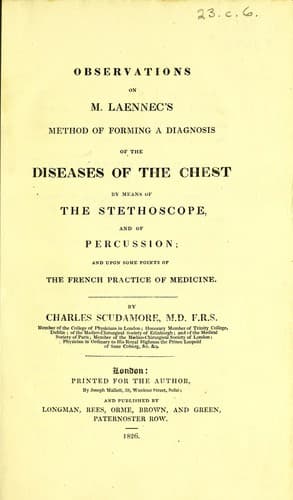
Observations on M. Laennec's method of forming a diagnosis of the diseases of the chest by means of the stethoscope, and of percussion; and upon some points of the French practice of medicineScudamore, Charles
Science
Observations on M. Laennec's method of forming a diagnosis of the diseases of the chest by means of the stethoscope, and of percussion; and upon some points of the French practice of medicine
Scudamore, Charles
Chest -- Diseases -- Diagnosis; Laennec, R. T. H. (René Théophile Hyacinthe), 1781-1826
I wish, however, to be understood, that in speaking of the employment
of calomel generally, I censure its abuse only. The proper use of it
deserves our confidence and best regard; and I think that the French
physician labours under great disadvantage in not having a just
practical acquaintance with the virtues of this excellent medicine,
which, as a remedy in various kinds of active disease, is without a
rival.
Chiefly on the principle of avoiding the frequent use of internal
medicine, it is a custom universal among the French to assist the
bowels by lavement; which, under circumstances of disease, is
variously medicated, but otherwise consists merely of water or gruel.
As an occasional remedy, this practice is most useful and important;
and, in certain cases of great delicacy of constitution, it may
be a very advisable substitute for aperient medicine, however
regularly it may be required: but under ordinary circumstances, as
a habit, it appears to me as objectionable in other respects as it
is inconvenient. When the bowel becomes much accustomed to this
artificial distension, it often fails to act without receiving such
solicitation; and hence a mechanical necessity is established for
this peculiar stimulus[5].
When the digestive powers of the stomach are unhealthy, and
particularly when the functions of the duodenum and of the liver are
also in error, as we usually see in established disorder of the
chylopoetic viscera, the propagated influence which may take place
from the lower bowel being stimulated to discharge its contents by
means of the lavement, is insufficient to remedy the functional
error existing so much higher up in the canal, and I have witnessed
examples in which serious complaint in the liver has made insidious
progress, from the circumstance of the patient having placed reliance
on this palliative relief, and neglected the employment of an
effective course of medicine.
The application of leeches, with a view to derive blood from the
vessels which communicate with those of the lower bowels, is a
practice quite common in France, and seems a favourite measure,
whatever viscus of the body may be affected. I have no doubt of the
utility of this mode of obtaining blood, when the lower part of the
intestinal canal is in a state of congestion; and, I may add, in many
cases of irritation. A gentleman had been troubled with diarrhœa,
which was often painful, for two or three months. It had resisted
the usual treatment by medicine. By one application of leeches near
the rectum he was cured.
Nature often points out the propriety of relieving the overloaded
circulation of the intestines, by the discharge of blood from the
hemorrhoidal vessels, and when, therefore, the indications for such
a mode of evacuation are presented, without any spontaneous relief
having taken place, the use of leeches is important. Also in certain
states of congestion of the uterine vessels, this method of local
depletion will be attended with advantage.
Public-domain text, read in full here on John Shaqi.
Reviews
Reviews
No reviews yet
Be the first to share your thoughts on this work.
Join the Discussion
Join the discussion
Sign in to leave a comment or review.
Sign InorCreate an account