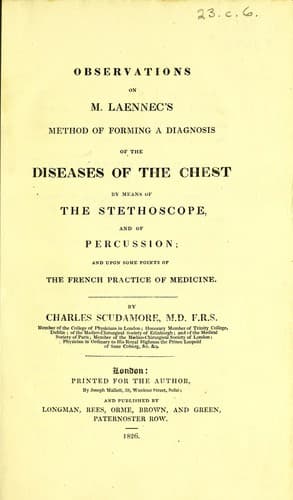
Observations on M. Laennec's method of forming a diagnosis of the diseases of the chest by means of the stethoscope, and of percussion; and upon some points of the French practice of medicine — John Shaqi
Observations on M. Laennec's method of forming a diagnosis of the diseases of the chest by means of the stethoscope, and of percussion; and upon some points of the French practice of medicineScudamore, Charles
Science
Observations on M. Laennec's method of forming a diagnosis of the diseases of the chest by means of the stethoscope, and of percussion; and upon some points of the French practice of medicine
Scudamore, Charles
Chest -- Diseases -- Diagnosis; Laennec, R. T. H. (René Théophile Hyacinthe), 1781-1826
_La médecine expectante_ is still the favourite method of practice
with many of the French physicians. I cannot undertake to say how
generally. When the principle is directed by a clear judgment,
there is much in it to be admired. A constant and too officious
interference by means of active medicines, may do serious injury to
the powers of the constitution; and, on such terms, the remedy may be
worse than the disease: but, on the other hand, to look on passively
as a spectator, and witness the formation of disease, forbearing all
active treatment until formidable symptoms take place, seems more
reprehensible even than excess of zeal in the use of medicine. I
approve the maxim, _Venienti occurrite morbo_.
In inflammations of the most important organs of the body, if we
allow delay, or want decision, the moment of being useful soon passes
away. It is incumbent upon us always to pay due attention to natural
indications, and to consider nature in the light of a good physician;
but I maintain that, in all instances of acute disease, and for the
most part in chronic, we may interpose our aid with certain benefit,
if we form a correct diagnosis, and come armed with just principles
of practice.
Within the last few years, new medical doctrines[6] have been
introduced in France, by M. Broussais, Professor at the Hôpital du
Val-de-Grâce at Paris; of which, the most important part relates to
the inflammation of the mucous membrane of the alimentary canal. This
inflammation is divided into acute and chronic, and is denominated
according to its situation; _gastrite_, when affecting the stomach;
_gastro-enterite_, when it extends from the stomach to the small
intestines; and _colite_, when confined to the colon.
The great importance of the functions of the stomach and intestines,
and the active sympathies which the stomach especially exchanges with
every part of the body, almost as a centre of the nervous system,
is one of the medical truths first taught in our schools, and is
constantly demonstrated to our observation, both in health and
sickness. But M. Broussais has extended to an unauthorized length,
his theories founded on the inflammatory affection of the mucous
membrane of the digestive canal; so that, if I mistake not, he
assigns to it almost an universality of influence.
Public-domain text, read in full here on John Shaqi.
Reviews
Reviews
No reviews yet
Be the first to share your thoughts on this work.
Join the Discussion
Join the discussion
Sign in to leave a comment or review.
Sign InorCreate an account