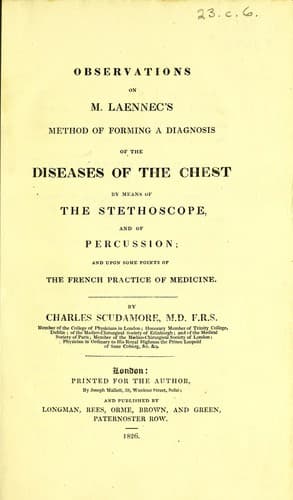
Observations on M. Laennec's method of forming a diagnosis of the diseases of the chest by means of the stethoscope, and of percussion; and upon some points of the French practice of medicineScudamore, Charles
Science
Observations on M. Laennec's method of forming a diagnosis of the diseases of the chest by means of the stethoscope, and of percussion; and upon some points of the French practice of medicine
Scudamore, Charles
Chest -- Diseases -- Diagnosis; Laennec, R. T. H. (René Théophile Hyacinthe), 1781-1826
In all cases of inflammation near the surface, in which the
detraction of blood is proper, the application of leeches is a
very eligible mode of treatment. I apprehend that blood is drawn
from a greater number of capillary vessels by this method than by
any other; such abstraction being favoured also by the gradual
and protracted evacuation of the vessels. It remarkably relieves
inflammatory action, either of the acute or chronic kind, in the
stomach and bowels. It is by no means so effectual in maladies of
the head and chest, in which cupping is a better mode of taking away
blood; although occasionally, even in those complaints, the use of
leeches may be more convenient, and even more appropriate.
Comparatively speaking, the practice of taking away blood by cupping
is very rarely resorted to by the French, and they appear to prefer,
in principle, the mode of bleeding by leeches, which they call
derivative; thus for the relief of the head, they apply them in the
neighbourhood of the rectum. That free cupping at the neck or behind
the ears, or opening the jugular vein when the vessels of the head
are in a state of congestion and increased action, is a far more
efficacious treatment, appears to me most unquestionable.
I consider it to be an important principle of treatment in regard to
the detraction of blood, in local inflammation, that we should make
it from the system, when the action of the heart is much increased
beyond the natural standard. When we have sufficiently reduced the
pulse, or, if in the first instance the general circulation do not
appear to be affected, it may be preferable to use cupping or leeches
only.
In active inflammation of any of the important organs of the body,
the _decided_ conduct of the English practitioner in using the
lancet as his chief remedy, promptly and boldly, and persisting till
the dangerous force of the disease is conquered, demands, in my
opinion, an undoubted preference over the more tardy, and I must
add, the inefficient methods of the French. This leading difference
in the method of treating dangerous inflammations, appears to me to
constitute the most remarkable distinction in the practice of the
English and the French physician.
I believe that severe and dangerous diseases are much less frequent
amongst the French than the English. There are physical and moral
causes to explain this fact. Their climate is less variable, and
less humid, than ours. They use a lighter diet; much more bodily
exercise, and they are a more cheerful people, constantly cultivating
amusement. Hence, probably, the general plan of French practice
is simple; and the use of _tisanes_ and _lavemens emolliens_ is
generally preferred to the employment of active medicines.
The pharmacien is not in any case permitted to prescribe; and no one
can open a shop for the sale and preparation of medicines, without
the permission of the authorities.
Public-domain text, read in full here on John Shaqi.
Reviews
Reviews
No reviews yet
Be the first to share your thoughts on this work.
Join the Discussion
Join the discussion
Sign in to leave a comment or review.
Sign InorCreate an account