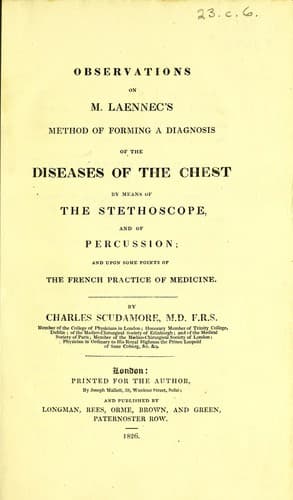
Observations on M. Laennec's method of forming a diagnosis of the diseases of the chest by means of the stethoscope, and of percussion; and upon some points of the French practice of medicineScudamore, Charles
Science
Observations on M. Laennec's method of forming a diagnosis of the diseases of the chest by means of the stethoscope, and of percussion; and upon some points of the French practice of medicine
Scudamore, Charles
Chest -- Diseases -- Diagnosis; Laennec, R. T. H. (René Théophile Hyacinthe), 1781-1826
In a late visit to Paris, I availed myself of the opportunity of
attending the principal hospitals; of inquiring into the general
practice of French medicine; and of studying, at the hospital of La
Charité, the method brought to so much perfection by M. Laennec, of
investigating the diseases of the chest; in regard to which, I had
also the advantage of receiving every kind attention and personal
instruction from this distinguished physician.
The method of which I now purpose to offer a brief account, embraces
the use of percussion and of the stethoscope.
It appears that percussion was first practised by Avenbrugger in
Germany, who published a treatise on the subject in the year 1761,
which was translated into French by the celebrated Corvisart, with
commentaries, in 1808. This author, in his Treatise on the Diseases
of the Heart, constantly founds much of his diagnosis on the
indications afforded by percussion.
The method consists in striking the respective parts of the chest,
which return a hollow kind of sound, when the contents of this cavity
are in a healthy state; but give a duller sound, when, from any
cause, there is impediment to the free entrance of air into the cells
of the lungs. When the obstruction is considerable, the perception is
very much the same as when you strike upon the thigh. The sound is
flat instead of hollow.
Simple as it may appear, there is a considerable tact in the mode
of percussing; and it is of importance to practise it in aid of the
information derived from the stethoscope.
The linen covering over the chest may remain, but thick dress should
be removed, and the surface also ought to be smooth. The integuments
should be rendered rather tense by the favourable position of the
arms. The four fingers being held close, bent, and a little curved,
the chest is to be struck rather sharply and in quick succession;
and when the indication of obstruction is manifest by the dulness of
sound, the corresponding part on the opposite side, is to be struck
with equal force; nice care being observed that all circumstances
are equal; as for example, the kind and strength of percussion, the
quantity of covering on the part, and the position of the patient. At
small points of examination, it will sometimes be convenient to use,
in the same manner, only two fingers; or, now and then, on a broad
surface, the flat hand, percussing rather slowly and gently.
M. Laennec displays no less skill and accuracy in his mode of
percussion than in the use of his stethoscope; and he attaches great
importance to it as an auxiliary source of information.
Public-domain text, read in full here on John Shaqi.
Reviews
Reviews
No reviews yet
Be the first to share your thoughts on this work.
Join the Discussion
Join the discussion
Sign in to leave a comment or review.
Sign InorCreate an account