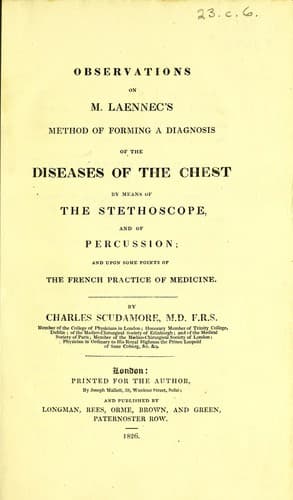
Observations on M. Laennec's method of forming a diagnosis of the diseases of the chest by means of the stethoscope, and of percussion; and upon some points of the French practice of medicine — John Shaqi
Observations on M. Laennec's method of forming a diagnosis of the diseases of the chest by means of the stethoscope, and of percussion; and upon some points of the French practice of medicineScudamore, Charles
Science
Observations on M. Laennec's method of forming a diagnosis of the diseases of the chest by means of the stethoscope, and of percussion; and upon some points of the French practice of medicine
Scudamore, Charles
Chest -- Diseases -- Diagnosis; Laennec, R. T. H. (René Théophile Hyacinthe), 1781-1826
Through the industry and ability of Dr. Forbes of Chichester, who
translated the work of Laennec in 1821, and who has also lately
published an original volume of great merit on the subject; and
through the medium of our medical journals, more especially the
excellent quarterly works published at Edinburgh by Dr. Duncan, jun.,
and in London by Dr. James Johnson, the professional public has been
made acquainted with the nature and uses of the stethoscope; but up
to the present time, it is so much a novelty in medical practice,
as well as with the public at large, that I trust no apology is
necessary for presenting an abridgment of the opinions of M. Laennec,
with a few reflections on the subject derived from my own observation
and practice.
As with percussion, the use of the stethoscope is founded upon a
simple philosophical principle; that of ascertaining whether the
cells of the lungs are healthy, and fitted for the free reception
of air in the function of respiration; or whether the membranes of
the chest, or the vessels, valves, and cavities of the heart, are
obstructed by any disordered action, or by any permanent disease.
The instrument which has received the name of _stethoscope_ (derived
from στῆθος, pectus, and σκοπέω, speculor or exploro), was invented
by M. Laennec; and the idea of it occurred to him from reflecting on
the well-known fact in acoustics, that the impression of sound is
augmented, when conveyed through certain solid bodies, as, when we
hear the scratch of a pin at one end of a piece of wood, on applying
our ear to the other. In examining a disease of the heart, he first
made use of a quire of paper rolled into a cylindrical form, and,
satisfied with the result, he soon proceeded to investigate the
various phenomena afforded by the vibrations of air within the chest,
through the medium of the stethoscope; which he constructed from the
suggestion already mentioned.
After making various experiments as to the form of the instrument,
and the kind of material, he found most success in using a wood of
medium density, as cedar. This proves very favourable for conveying
the delicate vibrations caused by respiration, from the walls of
the chest to the ear. For the information of those who have never
seen the instrument, I may observe, that it is of cylindrical form,
shorter in length, but larger in diameter, than the common flute.
It has a cylindrical perforation throughout its whole length, and
is divided into two parts for the convenience of using the whole or
half length, according to the situation of the patient in bed. The
end of each part terminates in a funnel-shaped cavity, the one to
receive the separate half of the instrument, and the other to receive
the part acting as a stopper, which latter has a short pipe, made of
brass or silver to enter the bore of the cylinder.
Public-domain text, read in full here on John Shaqi.
Reviews
Reviews
No reviews yet
Be the first to share your thoughts on this work.
Join the Discussion
Join the discussion
Sign in to leave a comment or review.
Sign InorCreate an account