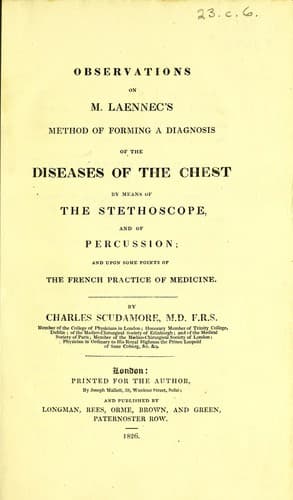
Observations on M. Laennec's method of forming a diagnosis of the diseases of the chest by means of the stethoscope, and of percussion; and upon some points of the French practice of medicineScudamore, Charles
Science
Observations on M. Laennec's method of forming a diagnosis of the diseases of the chest by means of the stethoscope, and of percussion; and upon some points of the French practice of medicine
Scudamore, Charles
Chest -- Diseases -- Diagnosis; Laennec, R. T. H. (René Théophile Hyacinthe), 1781-1826
For medicinal purpose, brucine is procured from “la fausse angusture”
(angustura ferruginea). The process is in most respects similar
to that employed for strychnine. It is administered in pills, and
has been employed in paralytic cases with reported success by M.
Magendie, and by M. Andrals fils, in doses from half a grain to five
grains; and it is assuredly a much safer preparation than strychnine.
The active properties of ipecacuanha have been found by M. M.
Magendie and Pelletier, to reside in an immediate principle
which they have called _emetine_. They consider that it may be
advantageously substituted for ipecacuanha, as an emetic, it being
divested of the offensive odour and taste of that substance, and
which M. Caventou found by experiment to be foreign to the emetic
qualities of the medicine. As an emetic, from a quarter to a whole
grain in solution may be first given, and a quarter or half a grain
repeated every twenty minutes till the due effect be produced.
_Veratrine_ is an alkali procured by a long chemical process from
the plants of the family of veratrum. It appears to be the chief
active principle residing in the colchicum autumnale, and in white
hellebore. M. Magendie states that the dose of a quarter of a grain
usually affects the intestinal canal rather powerfully. In a case of
apoplexy, he prescribed two grains in the twenty-four hours without
producing much effect on the bowels. He comments on this result,
as proving how much the state of the nervous system influences the
action of medicines.
M. Magendie suggests that the use of veratrine might be preferable
to the tincture of colchicum and the eau médicinale (which latter
medicine he considers to be substantially veratrine), on account of
the greater uniformity of the preparation.
In the treatment of gout, I am induced to avoid the active
preparations of colchicum entirely; and in employing the acetum
colchici, which is very mild, I use it only in combination with other
medicines, and desire to procure from its agency rather an auxiliary
operation, than that of colchicum distinctly. I have endeavoured to
explain my sentiments fully on the subject in my Treatise on Gout and
the disordered State of the Digestive Organs.
With these observations, I shall now conclude my summary view of
the nature of the principal new medicines, which have been added to
our list of remedies by the science and industry of our continental
neighbours[11].
It would lead to an interesting field of inquiry, were we to examine
the general customs and the habits of living in different countries,
in relation to health; and to trace the influence of climate, soil,
political and civil institutions, laws, religion, &c. But the subject
would demand a volume, rather than a few pages, and be foreign to my
present limited purpose.
Public-domain text, read in full here on John Shaqi.
Reviews
Reviews
No reviews yet
Be the first to share your thoughts on this work.
Join the Discussion
Join the discussion
Sign in to leave a comment or review.
Sign InorCreate an account