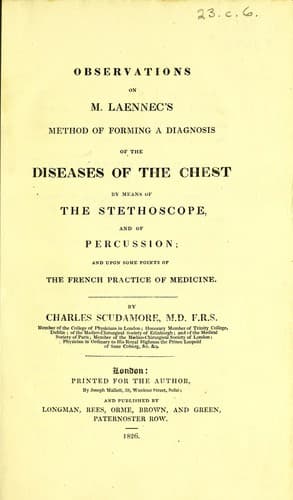
Observations on M. Laennec's method of forming a diagnosis of the diseases of the chest by means of the stethoscope, and of percussion; and upon some points of the French practice of medicineScudamore, Charles
Science
Observations on M. Laennec's method of forming a diagnosis of the diseases of the chest by means of the stethoscope, and of percussion; and upon some points of the French practice of medicine
Scudamore, Charles
Chest -- Diseases -- Diagnosis; Laennec, R. T. H. (René Théophile Hyacinthe), 1781-1826
In a case of long standing paralysis of one of the lower extremities,
I have had great cause to be gratified with the useful agency of
the alcoholic extract, in relieving the symptoms of neuralgia. The
patient, a gentleman between thirty and forty years of age, had been
afflicted with occasional pains of great severity coming on suddenly,
causing complete disability, lasting about twelve hours, and during
such period, producing exquisite tenderness of the limb. With the
abatement of pain, sleep followed; and, on awaking, this tenderness
had so completely passed away, that he could bear a free handling of
the parts; but the muscular power of the limb was weakened during the
day, it was frequently affected with convulsive action, and its usual
debility became much increased.
The case is in progress; but up to the present time the medicine has
evidently produced good effects, and without causing any tetanic
action of the muscles, which I have mentioned as being considered
desirable in some cases; although an unusual sense of tightness was
produced. Not the least pain has returned, and the limb is stronger.
When I had increased the dose to a grain and a quarter during two
days, the sense of tightness, joined with much feeling of weight,
became troublesome, and I suspended the use of the extract. In
forty-eight hours these symptoms disappeared, and the medicine has
been resumed without any kind of disagreement. I may add, with
satisfaction, that the retentive power of the bladder, which had been
for a long time affected, became materially improved.
It has been discovered by M. M. Pelletier and Caventou, that the nux
vomica, the bean of St. Ignatius, and the upas poison, owe their
active power over man and animals, to two particular vegetable
alkalies, the strychnine and brucine.
_Strychnine_ is procured in the state of crystals, by a complicated
chemical process, from the nux vomica. Its action on the animal
economy, as proved by experiments on dogs, is so extremely powerful,
that one would conceive it to be inadmissible as a medicine; but M.
Magendie relates that he has administered it in paralytic cases
with good effects. From an eighth to a quarter of a grain is the
usual dose. Brucine has been found combined with strychnine in the
nux vomica. In St. Ignatius’s bean, and in the upas, brucine bears
a similar relation to that which cinchonine has to quinine in the
cinchona barks, the strongest of which (cinchona cordifolia) contains
the largest relative proportion of quinine. In the same manner the
bean and upas, which are much more active substances than the nux
vomica, contain little of the brucine, and much of strychnine. In the
upas, strychnine is almost pure[10].
Public-domain text, read in full here on John Shaqi.
Reviews
Reviews
No reviews yet
Be the first to share your thoughts on this work.
Join the Discussion
Join the discussion
Sign in to leave a comment or review.
Sign InorCreate an account