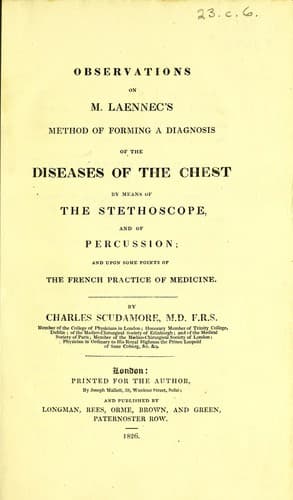
Observations on M. Laennec's method of forming a diagnosis of the diseases of the chest by means of the stethoscope, and of percussion; and upon some points of the French practice of medicineScudamore, Charles
Science
Observations on M. Laennec's method of forming a diagnosis of the diseases of the chest by means of the stethoscope, and of percussion; and upon some points of the French practice of medicine
Scudamore, Charles
Chest -- Diseases -- Diagnosis; Laennec, R. T. H. (René Théophile Hyacinthe), 1781-1826
From this examination the conclusion follows, that it is a water
containing a very minute quantity of solid ingredient. In one
thousand parts the specific gravity is only 2/10 higher than that
of distilled water. From the nitrate of silver causing so slight a
change, we see that the water is almost free from the muriates. It
is evident that the chief solid ingredients are the sulphate and the
carbonate of lime. Although I should certainly consider that a water
still less impregnated with these salts, and especially the sulphate
of lime, would be more wholesome, yet, when the small proportion
existing in this water is estimated, I am led to the conclusion, that
the disorder of the digestive organs, which commonly happens to the
visitors of Paris, is not attributable to the water of the Seine, but
to the new mode of living, and above all to the free, and sometimes
intemperate, use of the light acid or acescent wines. In such cases,
weak brandy and water should be substituted, and if wine be taken,
care should always be observed to procure such as is of the best
quality, and the most free from acid.
Since the printing of the sheets on the subject of the stethoscope,
I have met with many interesting and important cases, proving to
my further and complete satisfaction the value of the indications
afforded by the instrument.
In reverting to the subject, I shall offer a concise account of two
instances in which I derived an accuracy of instruction for my
treatment, which I could not otherwise have obtained.
A lady fifty years of age, who enjoyed good health generally, and
was not subject to cough, had been ill with symptoms of pneumonia
and bronchitis, a week before I was consulted. I found the following
symptoms: the pulse frequent, hard, and rather full; the skin hot;
cheeks flushed; the tongue much furred; the urine high-coloured, not
depositing sediment; the bowels torpid; cough rather occasional than
constant, but for the most part violent; the expectoration copious
and muco-puriform. In the upper parts of the right and left sides
of the chest, the indications afforded by the stethoscope were,
very sharp and strong sounds, both in inspiration and expiration,
conjoined with the mucous rattle. She did not experience any pain,
nor any sensible difficulty of respiration, although it was evident
that she did not breathe naturally; and fits of coughing were easily
excited. Her countenance had a very feverish and anxious look.
Previously to my visit she had been bled only once.
Public-domain text, read in full here on John Shaqi.
Reviews
Reviews
No reviews yet
Be the first to share your thoughts on this work.
Join the Discussion
Join the discussion
Sign in to leave a comment or review.
Sign InorCreate an account