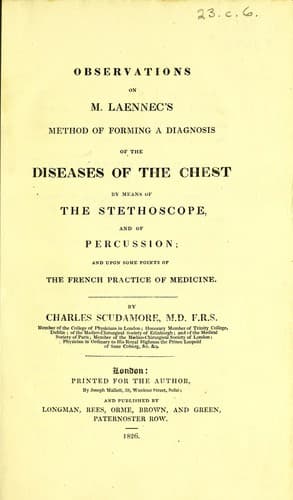
Observations on M. Laennec's method of forming a diagnosis of the diseases of the chest by means of the stethoscope, and of percussion; and upon some points of the French practice of medicineScudamore, Charles
Science
Observations on M. Laennec's method of forming a diagnosis of the diseases of the chest by means of the stethoscope, and of percussion; and upon some points of the French practice of medicine
Scudamore, Charles
Chest -- Diseases -- Diagnosis; Laennec, R. T. H. (René Théophile Hyacinthe), 1781-1826
I directed a free bleeding from the arm in the morning, and the
application of twenty leeches over the chest in the evening. I
prescribed small doses of tartar emetic, in a saline draught, every
four hours; some calomel, James’s powder, colocynth, and extract of
poppy at bed time, with a saline aperient in the morning, and other
general means. The blood was extremely cupped, with a dense buffy
coat. The bleeding from the arm was twice repeated in the course of
the three following days; and as the sounds were still indicated
by the stethoscope, although in a less degree, the leeches were
again applied twice in the course of the week; the medicines being
regularly administered. By these means the pulse became reduced from
one hundred and twenty to ninety, and acquired a degree of softness.
When the heat of skin abated, a blister was applied on the chest; but
it appeared to have the effect of creating more febrile irritation;
and without affording relief to the cough. I have observed this
disadvantage to follow from blistering in other cases of an inflamed
and irritable state of the lungs; and I apprehend that we should,
under such circumstances, take into consideration whether or not this
peculiar stimulus may produce more injury than benefit, from the
irritation which it creates in the chest being more influential than
the counter-action produced on the surface.
The tartar emetic proved very decidedly useful in its effects. I did
not increase the dose beyond three grains in the twenty-four hours,
and in the commencement of its use, the smaller doses occasioned
much sickness; but with the advantage of removing morbid secretions.
The cough becoming very irritable, syrup of poppy was added to the
saline antimonial draught; and, when all necessity for bleeding
was removed, the infusion of digitalis, in small doses, was also
employed; for, in this case, inflammatory action prevailed to a most
troublesome degree. Indeed, the complaint became chronic, the fever
decidedly hectic, and the situation of the patient appeared to be
precarious. The expectoration had strongly a puriform appearance,
was streaked with blood, and was very copious: its odour was faint,
but not particularly offensive. The sounds which I have mentioned
became less acute, and the rattle was more mucous. At this period
I directed the use of tartar emetic ointment over the chest, which
produced an extensive pustular eruption; and the advantage of this
counterirritation was very marked. I have the pleasure of adding
that this patient is now most favourably convalescent. She is taking
with advantage, as a mild restorative medicine, an infusion of the
cortical part of sarsaparilla in lime water, mixed with an equal
portion of milk made hot.
Public-domain text, read in full here on John Shaqi.
Reviews
Reviews
No reviews yet
Be the first to share your thoughts on this work.
Join the Discussion
Join the discussion
Sign in to leave a comment or review.
Sign InorCreate an account