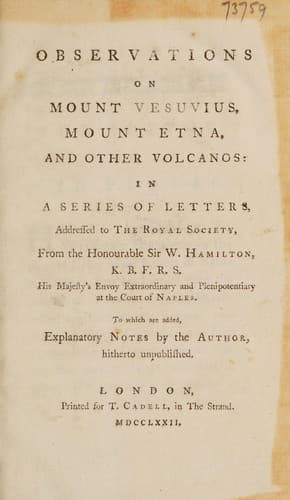
Observations on Mount Vesuvius, Mount Etna, and Other VolcanosHamilton, William, Sir
Science
Observations on Mount Vesuvius, Mount Etna, and Other Volcanos
Hamilton, William, Sir
Etna, Mount (Italy) -- Early works to 1800; Vesuvius (Italy) -- Early works to 1800; Volcanoes -- Italy -- Early works to 1800
The noise and smell of sulphur increasing, we removed from our villa to
Naples; and I thought proper, as I passed by Portici, to inform the
Court of what I had seen; and humbly offered it as my opinion, that his
Sicilian Majesty should leave the neighbourhood of the threatening
mountain. However, the Court did not leave Portici till about twelve of
the clock, when the lava had reached as far as (4. in Plate I.)--I
observed, in my way to Naples, which was in less than two hours after I
had left the mountain, that the lava had actually covered three miles of
the very road through which we had retreated. It is astonishing that it
should have run so fast; as I have since seen, that the river of lava,
in the Atrio di Cavallo, was sixty and seventy feet deep, and in some
places near two miles broad. When his Sicilian Majesty quitted Portici,
the noise was greatly increased; and the concussion of the air from the
explosions was so violent, that, in the King's palace, doors and windows
were forced open; and even one door there, which was locked, was
nevertheless burst open. At Naples, the same night, many windows and
doors flew open; in my house, which is not on the side of the town next
Vesuvius, I tried the experiment of unbolting my windows[9], when they
flew wide open upon every explosion of the mountain. Besides these
explosions, which were very frequent, there was a continued
subterraneous and violent rumbling noise, which lasted this night about
five hours. I have imagined, that this extraordinary noise might be
owing to the lava in the bowels of the mountain having met with a
deposition of rain water; and that the conflict between the fire and the
water may, in some measure, account for so extraordinary a crackling and
hissing noise. Padre Torre, who has wrote so much and so well upon the
subject of Mount Vesuvius, is also of my opinion. And indeed it is
natural to imagine, that there may be rain-water lodged in many of the
caverns of the mountain; as, in the great eruption of Mount Vesuvius in
1631, it is well attested, that several towns, among which Portici and
Torre del Greco, were destroyed, by a torrent of boiling water having
burst out of the mountain with the lava, by which thousands of lives
were lost. About four years ago, Mount Etna in Sicily threw up hot water
also, during an eruption.
The confusion at Naples this night cannot be described; his Sicilian
Majesty's hasty retreat from Portici added to the alarm; all the
churches were opened and filled; the streets were thronged with
processions of saints: but I shall avoid entering upon a description of
the various ceremonies that were performed in this capital, to quell the
fury of the turbulent mountain.
Public-domain text, read in full here on John Shaqi.
Reviews
Reviews
No reviews yet
Be the first to share your thoughts on this work.
Join the Discussion
Join the discussion
Sign in to leave a comment or review.
Sign InorCreate an account