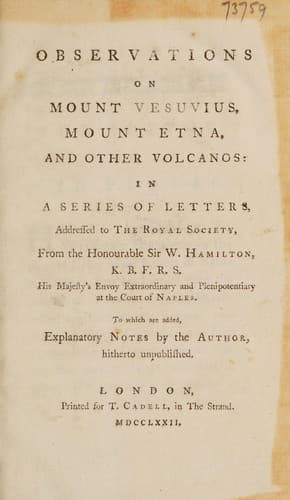
Observations on Mount Vesuvius, Mount Etna, and Other Volcanos — John Shaqi
Observations on Mount Vesuvius, Mount Etna, and Other VolcanosHamilton, William, Sir
Science
Observations on Mount Vesuvius, Mount Etna, and Other Volcanos
Hamilton, William, Sir
Etna, Mount (Italy) -- Early works to 1800; Vesuvius (Italy) -- Early works to 1800; Volcanoes -- Italy -- Early works to 1800
Tuesday the 20th, it was impossible to judge of the situation of
Vesuvius, on account of the smoak and ashes, which covered it entirely,
and spread over Naples also, the sun appearing as through a thick London
fog, or a smoaked glass; small ashes fell all this day at Naples. The
lavas on both sides of the mountain ran violently; but there was little
or no noise till about nine o'clock at night, when the same uncommon
rumbling began again, accompanied with explosions as before, which
lasted about four hours: it seemed as if the mountain would split in
pieces; and, indeed, it opened this night almost from the spot E to C
(in Plate I.). The annexed plans were taken upon the spot at this time,
when the lavas were at their height; and I do not think them
exaggerated. The Parisian barometer was, as yesterday, at 279, and
Fahrenheit's thermometer at 70 degrees; whereas, for some days preceding
the eruption, it had been at 65 and 66. During the confusion of this
night, the prisoners in the public jail attempted to escape, having
wounded the jailer; but were prevented by the troops. The mob also set
fire to the Cardinal Archbishop's gate, because he refused to bring out
the relicks of Saint Januarius.
Wednesday 21st, was more quiet than the preceding days, though the lavas
ran briskly. Portici was once in some danger, had not the lava taken a
different course when it was only a mile and a half from it; towards
night, the lava slackened.
Thursday 22d, about ten of the clock in the morning, the same thundering
noise began again, but with more violence than the preceding days; the
oldest men declared, they had never heard the like; and, indeed, it was
very alarming: we were in expectation every moment of some dire
calamity. The ashes, or rather small cinders, showered down so fast,
that the people in the streets were obliged to use umbrellas, or flap
their hats; these ashes being very offensive to the eyes. The tops of
the houses, and the balconies, were covered above an inch thick with
these cinders[10]. Ships at sea, twenty leagues from Naples, were also
covered with them, to the great astonishment of the sailors. In the
midst of these horrors, the mob, growing tumultuous and impatient,
obliged the Cardinal to bring out the head of Saint Januarius, and go
with it in procession to the Ponte Maddalena, at the extremity of
Naples, towards Vesuvius; and it is well attested here, that the
eruption ceased the moment the Saint came in sight of the mountain; it
is true, the noise ceased about that time, after having lasted five
hours, as it had done the preceding days.
Friday 23d, the lavas still ran, and the mountain continued to throw up
quantities of stones from its crater; there was no noise heard at Naples
this day, and but little ashes fell there.
Public-domain text, read in full here on John Shaqi.
Reviews
Reviews
No reviews yet
Be the first to share your thoughts on this work.
Join the Discussion
Join the discussion
Sign in to leave a comment or review.
Sign InorCreate an account