Observations on Mount Vesuvius, Mount Etna, and Other Volcanos — John Shaqi
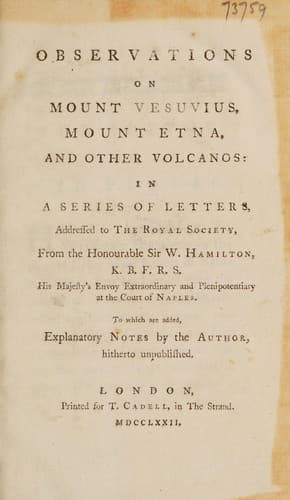
Observations on Mount Vesuvius, Mount Etna, and Other VolcanosHamilton, William, Sir
Science
Observations on Mount Vesuvius, Mount Etna, and Other Volcanos
Hamilton, William, Sir
Etna, Mount (Italy) -- Early works to 1800; Vesuvius (Italy) -- Early works to 1800; Volcanoes -- Italy -- Early works to 1800
It would require many years close application, to give a proper and
truly philosophical account of the Volcanos in the neighbourhood of
Naples; but I am sure such a history might be given, supported by
demonstration, as would destroy every system hitherto given upon this
subject. We have here an opportunity of seeing Volcanos in all their
states. I have been this summer in the island of Ischia; it is about
eighteen miles round, and its whole basis is lava. The great mountain in
it, near as high as Vesuvius, formerly called Epomeus, and now San
Nicolo, I am convinced, was thrown up by degrees; and I have no doubt
in my own mind, but that the island itself rose out of the sea in the
same manner as some of the Azores. I am of the same opinion with respect
to Mount Vesuvius, and all the high grounds near Naples; as having not
yet seen, in any one place, what can be called virgin earth. I had the
pleasure of seeing a well sunk, a few days ago, near my villa, which is,
as you know, at the foot of Vesuvius, and close by the sea-side. At
twenty-five feet below the level of the sea, they came to a stratum of
lava, and God knows how much deeper they might have still found other
lavas. The soil all round the mountain, which is so fertile, consists of
stratas of lavas, ashes, pumice, and now-and-then a thin stratum of good
earth, which good earth is produced by the surface mouldering, and the
rotting of the roots of plants, vines, &c. This is plainly to be seen at
Pompeii, where they are now digging into the ruins of that ancient city;
the houses are covered about ten or fifteen feet, with pumice and
fragments of lava, some of which weigh three pounds (which last
circumstance I mention, to shew, that, in a great eruption, Vesuvius has
thrown stones of this weight six miles[15], which is its distance from
Pompeii, in a direct line); upon this stratum of pumice, or _rapilli_,
as they call them here, is a stratum of excellent mould, about two feet
thick, on which grow large trees, and excellent grapes. We have then the
Solfaterra, which was certainly a Volcano, and has ceased erupting, for
want of metallic particles, and over-abounding with sulphur. You may
trace its lavas into the sea. We have the Lago d'Averno and the Lago
d'Agnano, both of which were formerly Volcanos; and Astroni, which still
retains its form more than any of these. Its crater is walled round, and
his Sicilian Majesty takes the diversion of boar-hunting in this
Volcano; and neither his Majesty nor any one of his Court ever dreamt of
its former state. We have then that curious mountain, called Montagno
Nuovo, near Puzzole, which rose, in one night, out of the Lucrine Lake;
it is about a hundred and fifty feet high, and three miles round. I do
not think it more extraordinary, that Mount Vesuvius, in many ages,
should rise above two thousand feet; when this mountain, as is well
attested, rose in one night, no longer ago than the year 1538. I have a
Public-domain text, read in full here on John Shaqi.
Reviews
Reviews
No reviews yet
Be the first to share your thoughts on this work.
Join the Discussion
Join the discussion
Sign in to leave a comment or review.
Sign InorCreate an account